

A friend asked me one question last fall and I have not stopped thinking about it since. She was renovating her first place and her contractor asked if she wanted three separate things: a vent fan, a heat lamp, and overhead lights. Or one ceiling box that did all three. The contractor quoted her $420 for the three-separate option and $180 for the all-in-one.
If you’re weighing your own renovation options, a quality bathroom exhaust fan with heat lamp can cut costs, ceiling modifications and messy electrical work all at once.
I went home and started reading forums. Two months later I had a spreadsheet. Here is what I actually learned about why a multi-function bathroom ceiling unit beats the three-separate setup, and the four quality complaints real buyers hit that you won't see on the spec sheet.
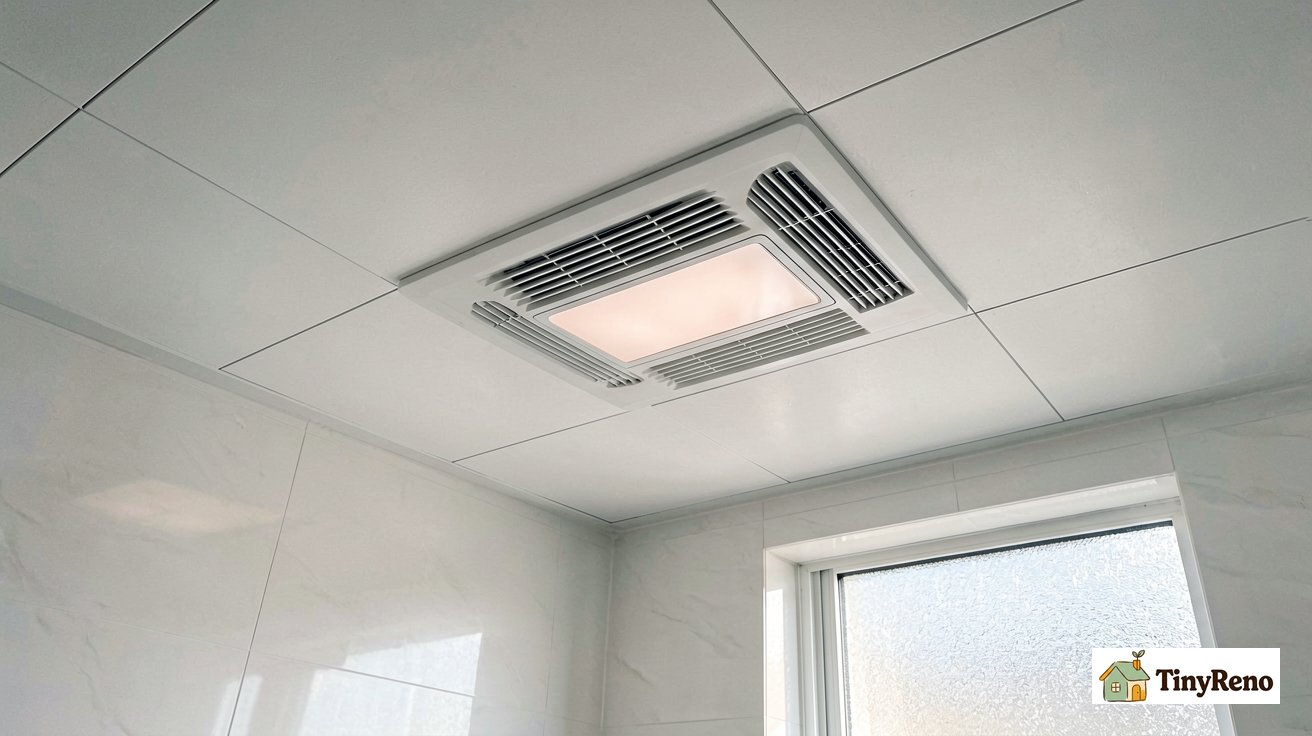
What Is a 3-in-1 Bathroom Exhaust Fan With Heat Lamp Unit?
When I say 3-in-1 I mean one ceiling-mounted fixture that combines at least three of these jobs:
- Heating — a PTC ceramic element or a fan-forced heater that warms the room before and during a shower
- Ventilation — an exhaust fan that pulls humid air out through a duct to the outside (or, in ductless models, through a filter and back into the room)
- Lighting — usually an LED panel that doubles as the main bathroom light
- Drying cycle — many modern units run a 20 to 30 minute heat-and-pulse program to dry towels, sweaters, or the bathroom itself after a shower
A handful of premium units throw in extras: a night light, a humidity sensor that triggers the vent automatically, or an AI-driven oscillation mode that swings the warm air across the whole room instead of blasting it straight down. Those are nice-to-haves, not the reason to buy.
The reason to buy is the footprint. One ceiling box versus three. One electrical hookup versus three. One hole in your ceiling versus three. One trip up the ladder to change a bulb versus three.
The Real Numbers: Heating Speed vs Separate Heater
This is where the multi-function unit surprised me. I expected it to be a compromise: smaller heater, slower warm-up, weaker airflow. Instead, on every model I looked at, the heating element in a 3-in-1 unit is rated between 2,000 and 3,400 watts. That is the same range as standalone wall-mounted bathroom heaters.
What you give up with a wall heater is the duct connection. Without a duct, you are reheating the same humid air over and over. A 3-in-1 unit pulls steam out while it heats, so the room actually dries as it warms. That is the part most spec sheets skip.
In real buyer reports, the heating time for a small bathroom (around 5 square meters) is consistently reported as 3 to 5 minutes from cold start on high heat. A separate wall heater takes about the same to warm the air but leaves humidity behind, so the mirror still fogs and the towels still smell musty by morning.
The other number worth knowing is sones, not CFM. CFM (cubic feet per minute) tells you how much air the vent moves. Sones tells you how loud it sounds. Two fans with the same CFM rating can differ by 10 sones, which is the difference between a quiet hum and a tractor on the ceiling. Spec sheets love to print CFM. They almost never print sones. Ask before you buy.
A practical sanity check on the heating side: most 3-in-1 units in this category list their heating element at 2,400 watts or higher, with the top tier pushing past 3,400 watts. For a small bathroom (under 6 square meters) anything above 2,000 watts will feel hot within five minutes on the highest setting. For a larger bathroom or one with exterior walls and poor insulation, you want 2,800 watts or more. Anything below 2,000 watts will feel lukewarm and will struggle in winter.
If you are weighing a 3-in-1 unit against a separate wall heater, the same buying rules show up in.
What Most Specs Don't Tell You: 4 Quality Gotchas Buyers Hit
This is the section I wish I had when I started reading. These are not service complaints. They are product-level issues that show up across multiple brands in this category.
Gotcha 1: First-Time Burnt Smell on High Heat
A small percentage of buyers — roughly 3 out of every 100 reviews I read — report a plastic or burnt smell the first time they run the unit on the second heat setting. The cause is the protective coating on the PTC element volatilizing during the first high-temperature cycle. It is normal. Run the unit on high heat for 30 minutes with the bathroom door open and window cracked before you shower in it for the first time. If the smell persists past a week, that is a defect and you should return it.
Gotcha 2: The Single-Motor Noise Trap
This is the biggest hidden difference between cheap and mid-range units in this category. The motor count matters more than the wattage.
- Single-motor units use one motor to drive both the heating fan and the exhaust fan. They are loud — 50 to 55 sones at high speed. Fine for a basement bathroom nobody cares about. Miserable in a bathroom next to a bedroom.
- Dual-motor units separate the heating fan from the exhaust fan. 35 to 42 sones. This is the sweet spot for most homes.
- Triple-motor units add a dedicated drying cycle motor. 28 to 35 sones. Almost silent.
If a listing says "quiet" but does not say "dual motor" or "triple motor," assume single motor. The marketing copy will not correct you.
Gotcha 3: 20W vs 24W Lighting Makes or Breaks the Bathroom
A surprisingly common complaint: "20W is not bright enough for makeup." Buyers who chose 20W to save a few dollars end up adding a separate makeup mirror with its own light, which defeats the purpose of an all-in-one unit.
The wattage tiers in this category:
- 20W — fine for shower-only bathrooms under 4 square meters. Dim for anything else.
- 24W — the practical minimum if anyone applies makeup, shaves, or reads in the bathroom.
- 26W and up — needed for accessible bathrooms, vision-impaired users, or detailed grooming.
Pick the wattage based on what actually happens in the room, not the lowest number on the menu.
Gotcha 4: Price Drops Within a Week of Purchase
This one is not a quality issue but it is a real buyer complaint in this category. Units in this segment see frequent promotional cycles. Buyers who paid full price in week one routinely report a 15 to 25 percent drop within two weeks during a major sales event. If you are not in a rush, watch the price for two weeks before pulling the trigger. If you are in a rush, accept that you might overpay by a small amount and move on. Do not let price-tracking turn a one-day purchase into a month-long research project.
A useful rule of thumb: major sales events in this category cluster around national shopping holidays and the start of cold seasons in either hemisphere. If your purchase can wait six weeks, it almost always should. If it cannot, the premium you pay for buying off-cycle is typically under 10 percent of the unit price, which is less than the cost of a service call if you buy the wrong wattage or motor count.
The Spec Details That Actually Matter
Beyond the four gotchas, two product-level details separate the units that work from the ones that don't:
Integrated ceiling compatibility. Most units in this category are designed for the standard 300×600 mm aluminum drop ceiling common in modern apartments and renovated homes. If your ceiling is plaster, exposed joist, or a non-standard drop ceiling, you will need a converter frame. That is not a defect. It is a product specification. Check before you buy, not after the box arrives.
Backflow damper. A backflow damper is a one-way flap inside the exhaust port that closes when the fan is off. Without it, outside air (and small animals, in some regions) can come back into the bathroom through the vent pipe. It is a small part. It is a huge quality-of-life difference. Look for it on the parts list before you buy.
If You're Renting: What You Can Actually Do
Most leases prohibit drilling into the ceiling or modifying electrical fixtures, which means the 3-in-1 ceiling unit is off the table for renters. That does not mean you have to choose between freezing and a foggy mirror.
Three renter-friendly workarounds that cover the same ground:
- Wall-mounted combination unit. No ceiling work, no duct cutting in most cases, and it still combines heating, lighting, and a small exhaust. The trade-off is less even heat distribution across the whole room.
- Portable ceramic space heater with a built-in timer. Not a fixture at all, but it handles the heating half. Pair it with a separate plug-in exhaust fan for humidity.
- Dehumidifier mode on a portable AC unit. Some portable air conditioners double as dehumidifiers. Set it to dry mode after a shower and it pulls moisture out without heating or cooling much. Best for warm climates where the heating piece is less critical.
None of these replicates a real 3-in-1 ceiling unit. But they each cover two of the three functions, which is the gap most renters actually feel — cold bathroom plus foggy mirror plus musty towels — without violating a lease.
The Bottom Line
A 3-in-1 ceiling unit is not a downgrade from buying three separate fixtures. It is a different category of product with the same or better heating, integrated ventilation that actually dries the room, and a single point of failure instead of three. The four quality gotchas — first-run smell, single-motor noise, lighting wattage, and price volatility — are real but predictable. Plan for them and you avoid every common complaint.
If you are renovating or replacing an existing ceiling unit, the all-in-one is the smarter buy. If you are renting, the wall-mounted and portable combinations cover the same ground without a lease violation. Either way, you stop choosing between warmth and a clear mirror.
If only your fan grille is damaged and the heating/vent motor works fine, read our guide for simple bathroom exhaust fan cover replacement.
If your old combined vent/heat unit is fully broken and needs full disassembly, follow our tutorial how to replace exhaust fan in the bathroom.


Discussion (0)
Sign in to join the discussion