

I called three Home Depot stores in February 2026 asking the same question: "How much does it cost to mud and tape drywall for a 12x12 bedroom?" Got three different answers. The first guy said $185, then clarified that was just the joint compound and tape if I did the work myself. The second said $310 with tool rental. The third said $420 for a contractor to handle everything. I went with the $185 option, spent two weekends covered in white dust, and ended up with a patch that looked fine from across the room and terrible from the couch. That's when I called the $310 guy. Here's what I actually learned.
What "Mudding and Taping" Actually Means
Before pricing anything, get clear on the work. "Mudding and taping drywall" is the finishing step after drywall sheets are hung. It covers:
-
Taping — pressing paper or mesh tape into the seams between drywall sheets to bridge the gap.
-
Mudding — covering the tape and screw heads with multiple coats of joint compound.
-
Sanding — smoothing the dried compound between coats.
-
Priming — sealing the porous mud before painting.
When I first heard the phrase 'mud and tape' I nodded along like I understood, then went home and Googled it. Basically, you stick tape over the seams where two sheets of drywall meet. Then you slather on the mud — that's joint compound — over the tape and screw holes. Then you sand it smooth and paint it. If you skip the primer, the patch shows through and you'll redo the whole thing in a month.
Most quotes bundle these three as one line item: "tape, mud, and finish." If you see a quote that only says "mud and tape," ask whether priming is included. It usually isn't.
I patched a hole smooth, painted over it, and stood back to admire my work. From across the room it looked fine. From the couch, it looked like a shiny square where the texture suddenly stopped. I didn't know aerosol texture cans existed until after I'd already painted. That's the kind of thing this article is for — the stuff you don't know you don't know.
Material Costs: What You'll Actually Buy
Material prices are the easy part to estimate because they don't vary much by region. Here's what a typical 4x8-foot wall repair needs, priced for a 2026 U.S. renter:
- Pre-mixed joint compound (1 gallon): $12-$18. Covers roughly 50-80 linear feet of seam for one coat. Most small jobs need 1-2 gallons.
- Setting-type compound (optional, for first coat): $20-$30 per 5-gallon bucket. Dries in 20-90 minutes instead of overnight — useful if you're impatient but harder to sand.
- Paper drywall tape (2-inch x 250 feet): $5-$7. A single roll handles most small jobs.
- Self-adhesive mesh tape (alternative): $8-$12 per 150-foot roll. Easier for first-timers but more crack-prone on long seams.
- Drywall taping knives (set of 3-4 sizes): $15-$25. The 6-inch is the workhorse; 10-inch and 12-inch for finish coats.
- Plastic mud pan: $5-$8.
- Sanding sponges or pole sander with screens: $8-$15 total.
- Primer (1 gallon): $15-$25. Don't skip this or the mud will flash through paint.
Total materials for a typical DIY drywall repair: $55-$95 for consumables (mud, tape, primer, sandpaper). Add $35-$50 for the essential tool set (knives, pan, masks) if you don't own them. If you're buying everything fresh, expect to spend $90-$140 total for your first repair. That's the realistic material cost to mud and tape drywall for one wall section.
Labor Costs: When You Pay Someone Else
If you're hiring a handyman or drywall finisher, labor is where the bill jumps. U.S. rates in 2026 typically run:
I posted a quick ad on Facebook Marketplace and got four responses in an hour. One guy wanted $85 an hour and told me he'd been doing this since before I was born. Another asked for $50 but when I asked if he could match the orange-peel texture on my wall, he said 'what's orange peel?' That's when I realized the price isn't just for labor — it's for knowing how to make the patch invisible.
The reason labor is so expensive is that finishing is slow. A pro spends most of their time waiting for coats to dry between applications, then sanding each one smooth. A single wall can take 3-4 days from first coat to final sand if you let each coat dry overnight.
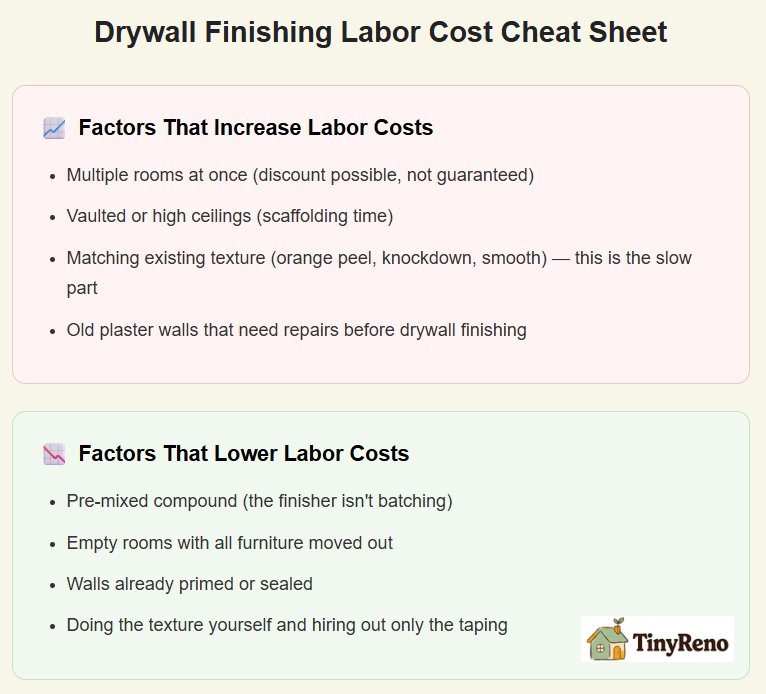
The thing that actually drives the price up is texture matching. I asked a guy if he could match my orange-peel walls and he said 'what's orange peel?' I hung up. The guy who knew what orange peel was charged double. High ceilings, old plaster, furniture in the room — all of that adds time. The only thing that makes it cheaper is if you've already moved everything out and the wall is clean. Otherwise, expect to pay for the inconvenience.
What I Actually Paid, Three Times
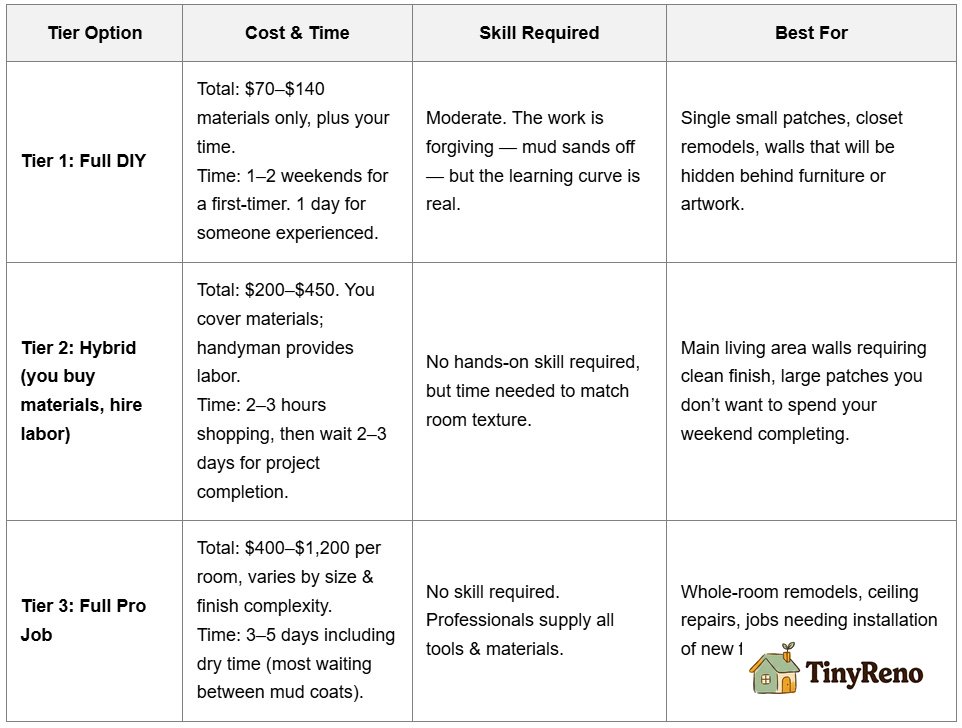
I tried this three different ways, in three different apartments. The first time I spent $75 on materials and two weekends of my life. The second time I paid a handyman $65 an hour to do the taping and mudding, then sanded and painted myself — total around $300. The third time I just wrote a check for $400 and let a pro handle everything. The pro job looked better. The $300 hybrid was the sweet spot. The DIY route I only recommend if you genuinely enjoy standing around waiting for mud to dry.
The Hidden Costs Most Renters Miss
These don't show up in drywall finishing cost calculators but will eat your budget if you skip them.
My apartment has orange-peel walls. I patched a hole smooth, painted over it, and stood back to admire my work. From across the room it looked fine. From the couch, it looked like a shiny square where the texture suddenly stopped. A can of aerosol texture is $12, and it would have taken five minutes to spray. I didn't know that until after I'd already painted.
And the dust. Sanding drywall produces a powder so fine it gets into your curtains, your coffee mug, your lungs. I did it without a mask for about ten minutes, then went to the hardware store and bought N95s. My apartment looked like it had snowed indoors.
Corner bead repairs
Outside corners (the edge where two walls meet) usually have a metal corner bead under the mud. If it's dented, rusted, or pulling away, fixing it costs $40-$100 extra per corner. A renter's deposit may catch this — a landlord doing a pre-move-out inspection will.
Dust control
Sanding drywall produces fine white dust that gets into everything. A roll of plastic sheeting ($10) and a box of 3M N95 masks ($15-$25) is not optional. Skip them and you'll be cleaning your apartment for a month.
Paint touch-ups beyond the patch
Patches rarely match the existing wall color exactly, especially if the original paint is more than a few years old. Most DIYers and many pros end up repainting the entire wall to avoid the visible patch outline. Budget $30-$60 for a gallon of matching paint if you go this route.
What a Renter Should and Shouldn't Pay For
Before you spend a dime, ask yourself one question: Whose fault is this hole? My first apartment had a crack running down the hallway from normal settling. I called the landlord, sent a photo, and he sent someone to fix it. Didn't cost me a thing. Two years later, I tried to mount a shelf using drywall anchors that were way too heavy for the job. The whole shelf pulled out and took a fist-sized chunk of drywall with it. That one was on me. I didn't even bother calling the landlord — I just fixed it myself.
Before you price anything, send your landlord a photo and ask whether the repair is on them. If they say yes, handyman labor is on them too. You still want to know the cost, but you're negotiating from "they pay," not "I pay."
For damage you caused, the math changes. A $300 patch might be worth it to avoid losing $500 from your deposit. A $50 patch is almost always worth doing yourself.
How to Actually Save Money Here
The cost to mud and tape drywall isn't really about finding a cheaper contractor. It's about avoiding scope creep. Three concrete moves that cut the bill:
- Pre-mixed everything. Setting-type compound and specialty muds cost more and dry faster, which sounds like a win until you sand them. For first-timers, pre-mixed all-purpose is the forgiving choice.
- Do the texture yourself if it's a small patch. Aerosol spray texture cans run $8-$12 and match most walls well enough for spots under 2 square feet. Skip the hopper gun rental.
- Don't prime over bare mud. Paint alone won't seal it; you'll see the patch through the paint. Use a dedicated drywall primer first ($15-$25), then paint. Skipping primer is the #1 reason patches show.
The Bottom Line
So, what did this whole adventure teach me? That mudding and taping drywall is not hard, but it is slow. And slow means expensive — either in your own time or in someone else's hourly rate. If I had to do it again tomorrow, I'd do the hybrid route: buy my own materials, pay a handyman for the taping and mudding, and handle the sanding, texture, and paint myself. It cost me around $300 and saved me from two weekends of frustration. And the first thing I'd do before any of it? Call the landlord and ask if it's their problem first.
What actually drives the cost is rarely the materials. It's the labor hours spent waiting for coats to dry and the time spent matching the existing texture. If you can live with a slightly imperfect match (in a closet, behind a bookshelf), you can do this for $100 and a Saturday. If you need it invisible, expect to pay at least $300 and probably closer to $500.
Either way, before you spend anything, check whether your landlord covers it. Many do, especially for settling cracks, water damage, and any ceiling work that needed a joist found first. Drywall finishing is one of those jobs where "tenant fixes it" usually means "tenant overpays for a fix the landlord should have covered."
The last thing I'll say: before you buy anything, text your landlord a photo. I didn't do that the second time, when a shelf pulled out of the wall and took a chunk of drywall with it. Cost me $300 to fix myself. Six months later I found out the same crack in my neighbor's apartment was fixed by the building for free because it was a settling issue. I paid for something that wasn't my fault because I didn't ask. Ask first. Everything else is just math.


Discussion (0)
Sign in to join the discussion