

My roommate Mark hadn't paid rent in 6 weeks. It was a Tuesday night in October 2017, I was sitting at the kitchen table in our Chicago 2b1b, and I had just realized that if he didn't pay by Friday, my credit score was going to take the hit before his did.
This post is not legal advice. It is what I actually did, in order, to get him out of my apartment — and the one step I would skip if I could go back.
If you need to evict a housemate, here is the order that worked for me, plus the lessons that cost me money and stress the first time around.
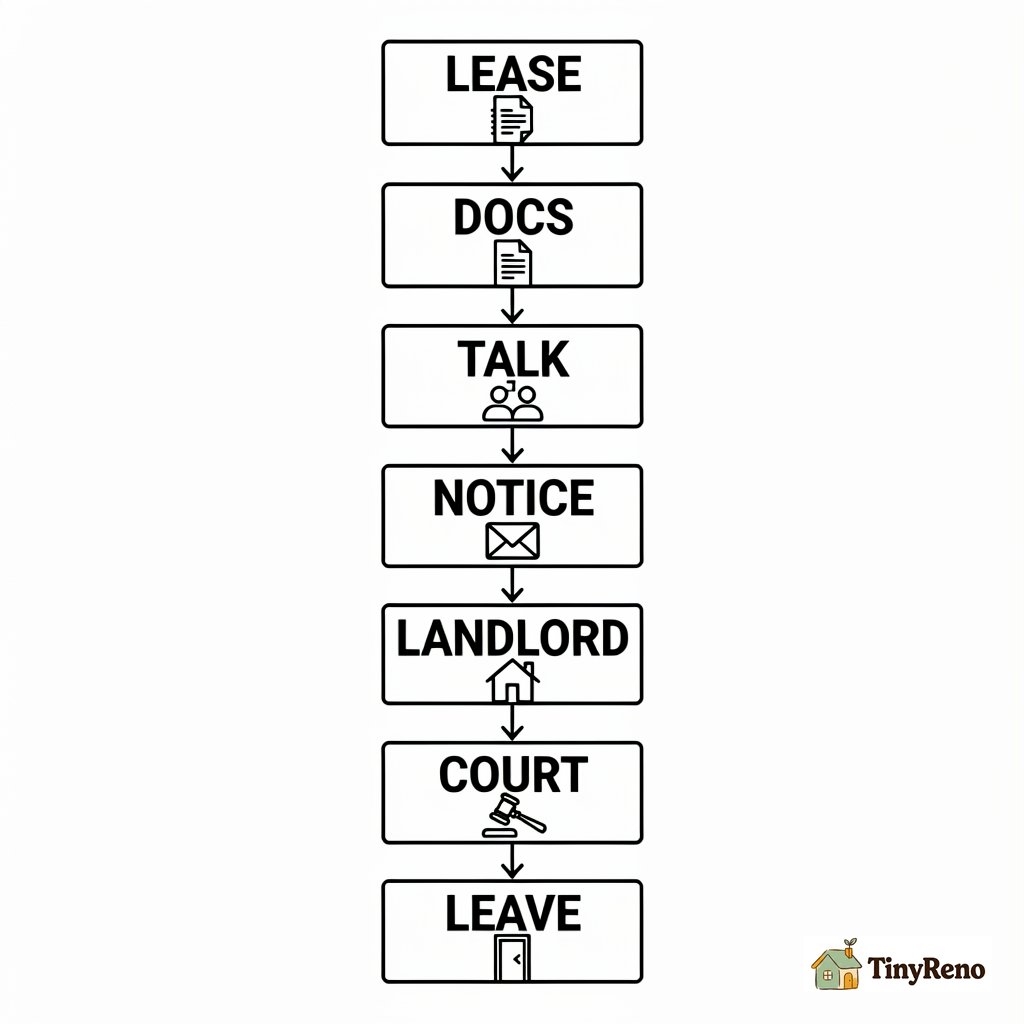
Step 1: Read your lease — who is actually on it?
Before you do anything else to evict a housemate, pull out your lease and read the names section. There are three structures that matter:
- Joint tenancy. Every roommate signs the lease as one unit. The landlord can pursue any one of you for the full rent. This is the most common setup and the most dangerous for the paying roommate.
- Individual room lease. Each roommate has their own lease for their bedroom and shares common areas. You are only responsible for your own rent. Eviction paths differ.
- Roommate agreement. You and your roommates signed a separate document between yourselves. This does not bind the landlord. It only governs how you split rent among yourselves.
Mark and I were joint tenants. That meant when he stopped paying, the landlord came after me for the full $1,950. My name was on the lease. His was too, but the landlord chose me first because I had a job and Mark did not.
Step 2: Document everything before you confront them
You will need paper evidence if this escalates to your landlord, a mediator, or a court. Start a folder — physical, digital, or both — labeled with the roommate's name and "rent." Every month, on the 1st, drop in:
- Screenshot of the roommate's payment app showing $0
- Text message exchange about rent
- Bank statement showing you paid their share
I started this in month 4 of Mark's slow-fade. I wish I had started in month 1. By month 6, when I finally brought the issue to the landlord, I had six months of evidence in a single Gmail folder. The landlord took the situation more seriously because the trail was clean.
Step 3: Talk to them — but with a witness
Most roommate disputes are solvable with a direct conversation. People fall behind on rent for many reasons: job loss, medical bills, depression, plain avoidance. Some of those people will fix the problem if you raise it calmly. Some will not.
The key rule: do not have this conversation alone. Bring a third party. A mutual friend, another housemate, or your building manager. The third party's role is not to referee. Their role is to be a witness if the conversation later matters.
I had this conversation in our living room with my friend Jess sitting at the kitchen counter. I told Mark he was 6 weeks behind, that I had covered his share for two of those months, and that I needed a plan by Friday. Jess heard everything. Two months later, when the landlord got involved, Jess's account of that conversation is what kept the timeline straight.
Step 4: If talking fails — give a written notice
If your roommate does not respond, or responds with promises they break, the next move is a written notice. Most states require at least 30 days for a month-to-month tenancy, and many leases require 30 days even for fixed-term tenants who are being asked to leave early.
Two delivery methods work:
- Certified mail. Costs a few dollars at the post office. Returns a receipt with their signature. Court-proof.
- Hand-delivered with a witness signature. Print the notice, hand it to them in person, have your witness sign the back of your copy noting date and time.
Do not rely on text messages or emails alone. Courts often rule those insufficient for "notice" purposes. The notice itself should be short: name, address, the date by which they need to vacate, and your signature.
Step 5: If they still won't leave — talk to your landlord
This is the step most paying roommates are afraid to take. They worry that the landlord will see them as a problem tenant too. In my experience, the opposite is true.
Most landlords do not enjoy turning over units. Turnover costs them real money — cleaning, repainting, listing fees, vacancy months. If a roommate is the source of the problem, your landlord usually wants to resolve it.
Here is what I said to my property manager on a Wednesday morning: "Mark hasn't paid rent in 6 weeks. I have covered his share twice. I need to know what my options are." By Friday afternoon, the property manager had issued Mark a 3-day notice to pay or vacate. Mark moved out 4 days later.
The landlord did not see me as the problem. He saw me as the paying tenant keeping the unit solvent while his other tenant refused to honor the lease.
Step 6: If your landlord won't help — understand the legal eviction process
Sometimes the landlord is hands-off, slow, or refuses to act. In that case, your path is the formal eviction process — and you should understand it before you start.
The sequence is roughly:
- You file an eviction action in your local housing court.
- The court issues a summons to your roommate.
- The roommate has a window (often 5 to 30 days) to respond.
- If they don't respond, you win by default. If they do, there's a hearing.
- If you win, the court issues a writ of possession.
- The sheriff or constable physically removes the roommate if they still haven't left.
Realistic timeline: 2 to 8 weeks, depending on your state and court backlog. Cost: filing fees of $50 to $300, plus possible attorney fees if the case is contested.
What you must not do: change the locks, remove their belongings, shut off utilities, or otherwise force them out without a court order. This is illegal self-help eviction. In some states it is a misdemeanor. It will also torpedo your case if they file first.
What I'd do differently now
Three things I missed in 2017 that I would not miss again:
- Run a credit and background check before move-in. Mark had a recent eviction on his record that I never saw because we met through a mutual friend and I trusted the referral. A $30 background check would have saved me $7,800 in unpaid rent and lost sleep.
- Push for individual room leases. Joint tenancy puts the paying roommate on the hook. If you can negotiate individual leases with your landlord, do it. It costs more paperwork but limits your downside.
- Set up a small emergency fund specifically for roommate default. Even $500 in a separate account means you can cover a missed month without your own rent check bouncing. It also gives you breathing room to act instead of panic.
Evicting a housemate is stressful, expensive, and slow. The steps above are the path I walked. The one I would skip if I could do it again is Step 6 — if I had gone to my landlord in week 4 instead of week 8, I would have avoided most of the damage to my own credit and my own stress level.
If you are reading this because you are about to evict a housemate of your own: start at Step 5 tomorrow morning. Do not wait six weeks like I did.


Discussion (0)
Sign in to join the discussion