

When my friend Marcus inherited his dad's1962 bungalow in Tampa in early2023, the first argument he and his wife had with the house was about the ceiling. The living room had the original popcorn texture from when the house was built, his wife wanted a modern smooth ceiling, and his dad (still alive, still opinionated) kept insisting that the only texture that "looked like the house" was stucco ceiling. Three opinions, one ceiling, and a roughly $4,000 decision that took them six weeks to make. Here is what a stucco ceiling actually is, the four ways a contractor installs one, how it compares to popcorn in five dimensions, and the decision tree Marcus now uses to give other friends advice when they ask.
The Four Stucco Ceiling Textures and How to Tell Them Apart
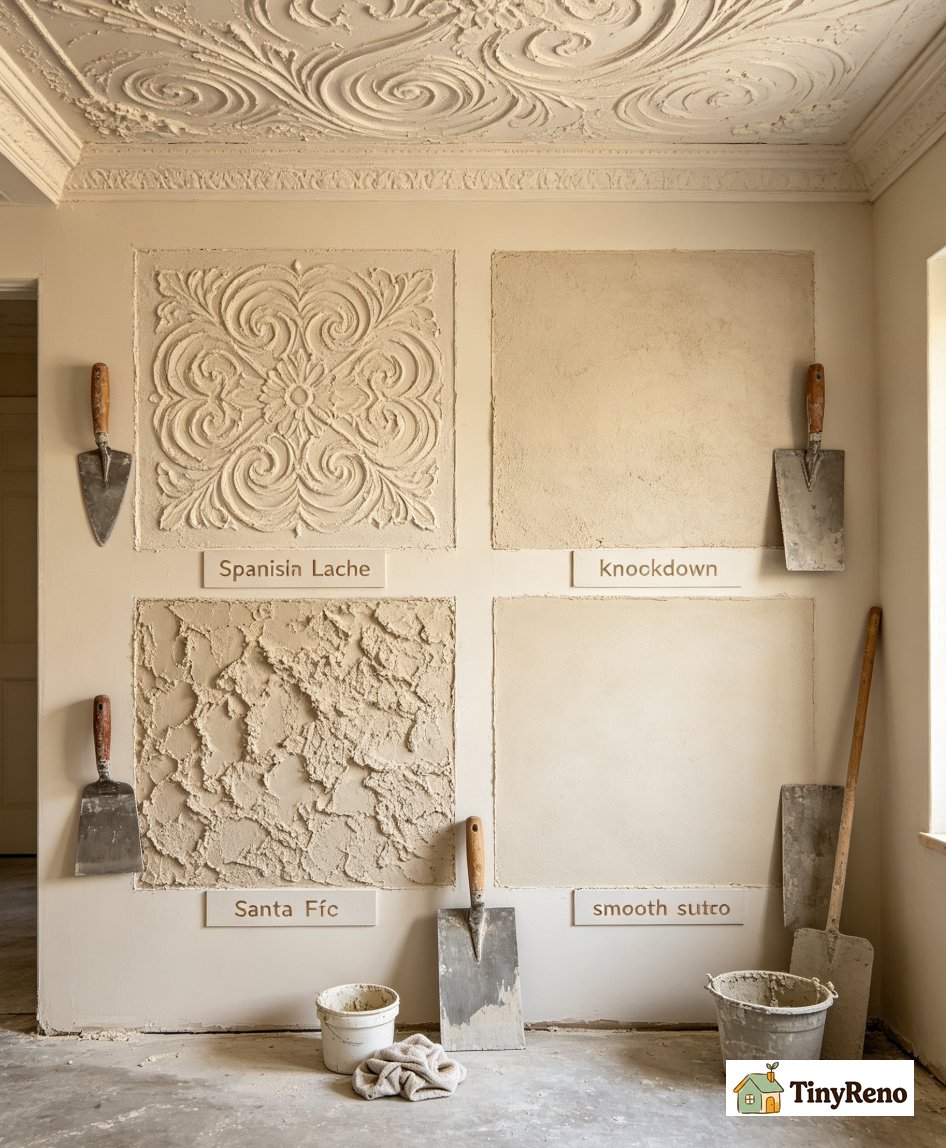
Before Marcus hired anyone, his contractor Sofia walked him through a sample board with four squares of stucco ceiling texture, because "stucco" is not one thing. It is a family of finishes made from Portland cement, lime, sand, and water, applied wet and then shaped while still soft. The four most common styles you will see in American homes are Spanish lace, knockdown, Santa Fe, and smooth stucco.
Spanish lace is what most people picture when they hear "stucco ceiling." It is the swirly, almost cloud-like texture you see in roughly90% of stucco ceilings in older U.S. homes. The applicator sprays or hand-trowels the wet mix on, then lightly presses a curved trowel across it in overlapping arcs. The result has visible peaks and shallow valleys, and it hides imperfections in the underlying drywall well. This is the one Sofia recommended for Marcus because it matches what a 1962 house would have had.
Knockdown is the flatter sibling of Spanish lace. The same wet mix is applied, but after a few minutes the applicator runs a flat trowel across the surface once, knocking down the peaks so only the valleys remain. It reads as "subtle texture" rather than "obviously textured." It is what you see in many newer suburban tract homes built in the 1990s and 2000s.
Santa Fe (sometimes called "adobe" or "Spanish rough") is the heaviest of the four, with deep ridges and a more rustic, almost hand-sculpted look. It is most common in the American Southwest and in custom homes where the owner wants an Old World feel. It is harder to paint over cleanly because the deep ridges catch roller drips.
Smooth stucco is the rarest. It is a thin, plaster-like layer that is troweled flat and then lightly polished. It looks similar to a level-five smooth drywall finish, but it costs more than any of the textured versions because the finisher has to be skilled enough to keep the surface flat over an entire ceiling. Most production homes use one of the three textured versions.
The Four-Step Process Sofia Used to Install Marcus's Stucco Ceiling
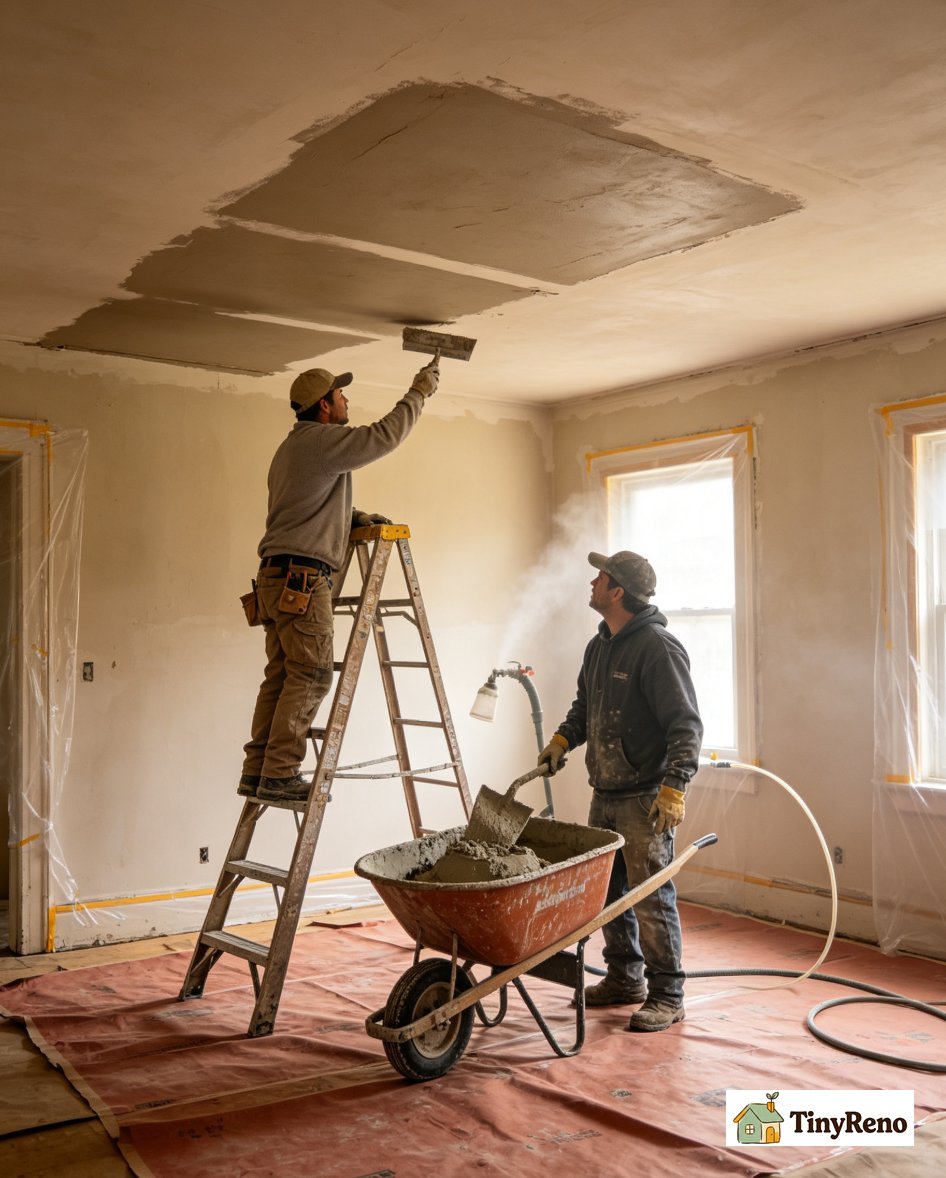
Sofia gave Marcus a written estimate that broke her $3,800 job into four clear steps. This is what a typical professional stucco ceiling install actually looks like on site, in order.
Step one, prep the room. Furniture out, floors covered with rosin paper or canvas drop cloths, walls masked with plastic sheeting taped at the ceiling line. A stucco job is wet and messy. Any surface you do not want textured gets covered. Sofia's crew spent a full half day on prep alone for a 220 square foot living room.
Step two, mix the stucco. Portland cement, hydrated lime, sand, and water in specific ratios (typically one part cement, one part lime, six parts sand, plus enough water to reach a thick paste consistency). Premixed bags exist for small jobs, but a220 square foot ceiling uses about 200 pounds of dry mix, so Sofia's crew mixed in a wheelbarrow on site. The mix has a working time of roughly90 minutes before it starts to set, so timing matters.
Step three, apply in two coats. The first coat is a base, sprayed or hand-troweled on to give the substrate a uniform thickness and good adhesion. The second coat is the texture coat, applied while the first is still tacky, and this is where the Spanish lace pattern gets pressed in. Sofia used a curved trowel and worked in roughly four-foot sections so she could finish each section before the previous one set. The total spray-and-texture pass took about three hours.
Step four, cure and paint. Stucco needs to cure slowly over roughly seven days, which means the room needs to stay ventilated but not too dry (no AC blasting directly at the ceiling). Once cured, the ceiling is primed with a masonry primer and then painted with flat ceiling paint, ideally sprayed to avoid filling in the texture with a roller. Marcus hired a separate painter for $600. Total job: $3,800 plus $600 paint, all in.
Popcorn vs Stucco Ceiling: Five Dimensions Marcus Compared
Marcus's wife wanted to know, before signing Sofia's contract, why they were not ripping out the popcorn and going smooth instead. Here is the five-dimension comparison they ended up using, because "popcorn or stucco" is not actually about taste, it is about cost, repair, and what the house can carry.
Look and feel. Popcorn is a dry-spray acoustic texture with small bumps that scatter light and visually flatten a ceiling. Stucco is a wet-applied cement texture with more deliberate patterns that catch light and add depth. Stucco reads as traditional or Mediterranean. Popcorn reads as1970s-to-1990s suburban. For a1962 bungalow, stucco matched the architecture. For a 2000s tract home, popcorn was the original choice.
Install cost. Popcorn can be DIYed for roughly $1 to $2 per square foot in materials (dry mix, sprayer, primer, paint). Professionally installed stucco runs $3 to $5 per square foot for the texture coat alone, plus $2 to $3 per square foot for paint if sprayed. On Marcus's 220 square foot living room, that is the difference between about $440 in DIY popcorn and $3,800 professionally textured stucco plus $600 paint.
Repair cost. Popcorn is famously hard to patch invisibly because matching the exact dry-spray pattern from a decade ago is nearly impossible, which is why popcorn damage almost always turns into a "retexture the whole ceiling" job. Stucco, by contrast, can be patched section by section. A handyman mixes a small batch of the same cement-lime-sand recipe, presses it into the damaged spot, and matches the surrounding texture while wet. Marcus's friend Ben paid $180 last year to patch a water stain in his Spanish lace stucco, and the patch is invisible.
Paint-ability. Popcorn holds paint, but only if you use a thick-nap roller and lots of paint to push into all the nooks. Stucco also holds paint but the peaks and valleys show every roller mark, which is why the pros spray it. If you plan to repaint every five years, both are workable, but popcorn is friendlier to DIY paint and stucco almost requires a spray rig.
Sound and light. Popcorn, because of its acoustic-spray origin, genuinely absorbs a little more sound than stucco. If you have a noisy upstairs neighbor, popcorn is the slightly better choice. Stucco reflects a little more sound but has more visual depth and catches light in a way that popcorn does not, which is why a stucco ceiling can make a small room feel less flat.
Three Problems a Stucco Ceiling Can Develop and What Each Costs to Fix
It has been roughly eighteen months since Marcus's stucco ceiling was installed, and he has had three small issues, all normal for a cement-based finish on a wood-framed house that breathes with the Florida humidity.
Hairline cracks along corners. Where the ceiling meets the wall, small settlement cracks appeared within six months. This is normal for any texture on a wood-framed house. Fix is mesh tape plus a thin layer of joint compound over the crack, then dab on matching texture (Sofia left Marcus a small sealed bucket of leftover mix for exactly this), let it cure, and touch up the paint. Cost: $15 in materials and one afternoon.
Brown water stain from a slow leak above. Last summer the upstairs AC condensate line clogged and dripped onto a section of ceiling for two days before Marcus noticed. The wet spot cleaned up with a magic eraser and repaint once the leak was fixed. Cost: zero for the stucco itself, $120 for the HVAC tech to unclog the line, and $25 in paint. If Marcus had ignored the leak, the stucco would have eventually softened and detached from the drywall behind it, at which point the repair is cutting out the bad section and redoing the texture.
A small sagging section near the light fixture. The old light fixture box was loose in the ceiling, and over time the drywall behind it flexed every time someone changed a bulb. The stucco did not actually sag, but a hairline crack radiated out from the box. Fix was to tighten the fixture box to a proper ceiling fan-rated brace, then patch the crack and dab on new texture. Cost: $40 in electrical parts, $20 in stucco patch materials, two hours.
A Short Decision Tree for Choosing Stucco, Popcorn, or Smooth Ceiling
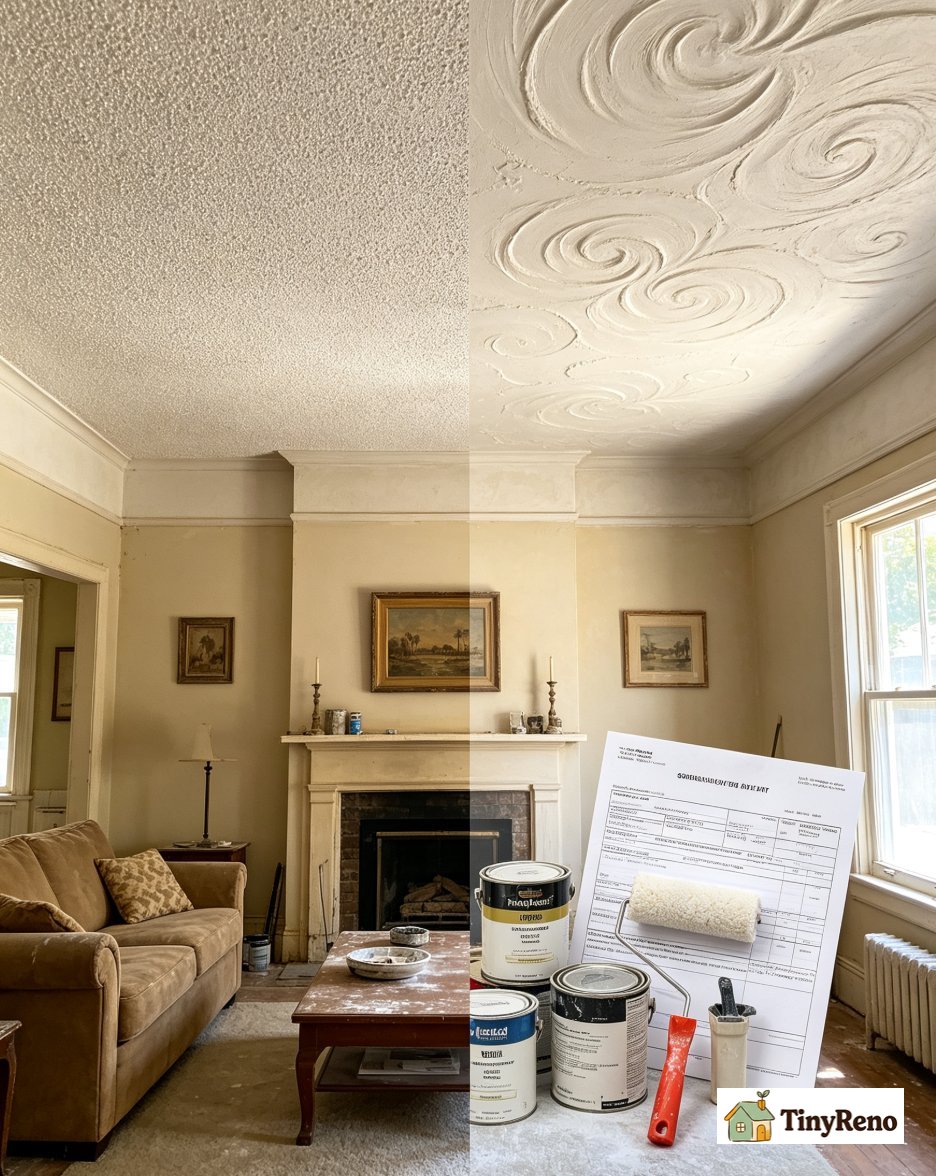
Marcus's friend Ben called him last week asking the same question Marcus asked Sofia. Marcus gave him this decision tree in five minutes and Ben booked Sofia the next day. Here it is, written out so you can use it without calling Marcus.
If your house was built before the1980s and the existing ceiling has any texture at all, keep the texture. Match the original. Stucco for Mediterranean, Spanish, or Southwest homes. Knockdown for ranches and colonials. Popcorn for mid-century moderns. Tearing out a period-correct texture and going smooth almost always drops the resale value because buyers in those neighborhoods expect the texture.
If your house was built after2000 and the ceiling is smooth or knockdown, stay smooth. Modern buyers in newer construction expect flat ceilings. Adding stucco or popcorn to a 2010s home reads as "covering something up" and can actually lower offers.
If you have popcorn and hate it but the budget is tight, do not scrape and retexture. Paint the popcorn with a bright white flat ceiling paint using a thick-nap roller. The paint fills the visual noise, makes the bumps look softer, and costs about $50 in materials. Most people who hate popcorn stop hating it once it is freshly painted.
If you have popcorn and want to upgrade the value of the home before selling, stucco is the upgrade that buyers notice. A professionally installed Spanish lace stucco ceiling runs $3 to $5 per square foot, but it lifts the perceived value of a 1970s or 1980s home by more than the cost in most metro markets, because it signals "this house has been cared for."
If you have popcorn and there is any chance it contains asbestos (homes built before1986 in the US, before1990 in Canada), do not scrape it. Get it tested first, and if it is positive, either leave it and paint over it, or have it professionally removed by a licensed abatement crew. Popcorn is the only common ceiling texture that hides asbestos, which is the main reason it has the reputation it has. Stucco applied on top of popcorn is a legal, common, and good-looking solution if you do not want to deal with abatement.
Why Marcus Made the Right Call for a 1962 Bungalow
Marcus's dad visited three months after the install. He walked into the living room, looked up at the new Spanish lace stucco ceiling, and said nothing for a long moment. Then he said, "Now it looks like the house my father built." Marcus's wife had worried the texture would feel heavy or dated. It does not. It feels intentional, the way a poured concrete countertop feels intentional. It is the texture of a house that knows what it is. Sofia's crew finished in five working days. The texture will outlast the next paint job and the one after that. When the next owner buys the house, they will probably look up, smile, and never think about the ceiling at all, which is the highest compliment a ceiling can earn.


Discussion (0)
Sign in to join the discussion