

Landlord repair responsibilities under state law look the same in every state, but my own case started with a sink that would not drain. I assumed the landlord would fix it because the sink was part of the unit when I moved in. I was right. But the next repair was a kitchen cabinet door with a loose hinge, and the landlord told me "that's tenant responsibility, fix it yourself." I assumed he was right. He was wrong about what the landlord repair responsibilities actually covered.
The confusion came from treating state laws on landlord repair responsibilities as a single rule. They are not. Every state's law on landlord repair responsibilities splits repairs into three buckets, and the rules are different for each bucket. Knowing which bucket your repair falls into determines whether you have a legal right to demand the fix, how fast the landlord must act, and what you can do if the landlord refuses to honor landlord repair responsibilities state law requires.
This article is the 3-bucket rule. Bucket 1 is habitability and safety — repairs the landlord must make in 24 hours to 14 days, with no negotiation. Bucket 2 is major systems and appliances — repairs the landlord must make within a reasonable time, often 14 to 30 days. Bucket 3 is cosmetic and tenant-caused — repairs the landlord can decline without legal consequence. The lookup table at the bottom shows the default bucket for each common item. Most states follow these defaults, but a few have exceptions—check your state's statute for the exact rule.
Once you know which bucket your repair falls into, the rest of the dispute becomes mechanical: send the right kind of request, wait the right amount of time, and escalate through the right channel.
Why Landlord Repair Responsibilities Look the Same but Aren't
Every state's habitability law uses different language. California's "implied warranty of habitability" includes weatherproofing, plumbing, heating, electrical, ventilation, and structural integrity. New York's "warranty of habitability" covers similar items but adds vermin control and clean common areas. Massachusetts focuses on "fit and habitable" with detailed minimum standards. Florida requires the landlord to maintain the "structural, mechanical, and electrical components in good repair."
Different language, similar categories. The categories are the 3 buckets. The 50-state lookup at the bottom of this article shows which bucket each item falls into in your state.
Why the bucket matters more than the specific statute: the bucket determines the timeline, the consequence of non-compliance, and the tenant's remedy. Bucket 1 items (no heat in winter, gas leak, broken exterior lock) are emergencies with 24-hour deadlines. Bucket 2 items (broken dishwasher, slow drain, aging carpet) are routine with 14 to 30-day deadlines. Bucket 3 items (loose cabinet hinge, scuffed paint, worn doorknob) are usually not legally required repairs at all.
If you ask for a Bucket 1 repair and the landlord takes 14 days, you have a strong habitability claim. If you ask for a Bucket 3 repair and the landlord refuses, you have no legal claim — only a negotiation.
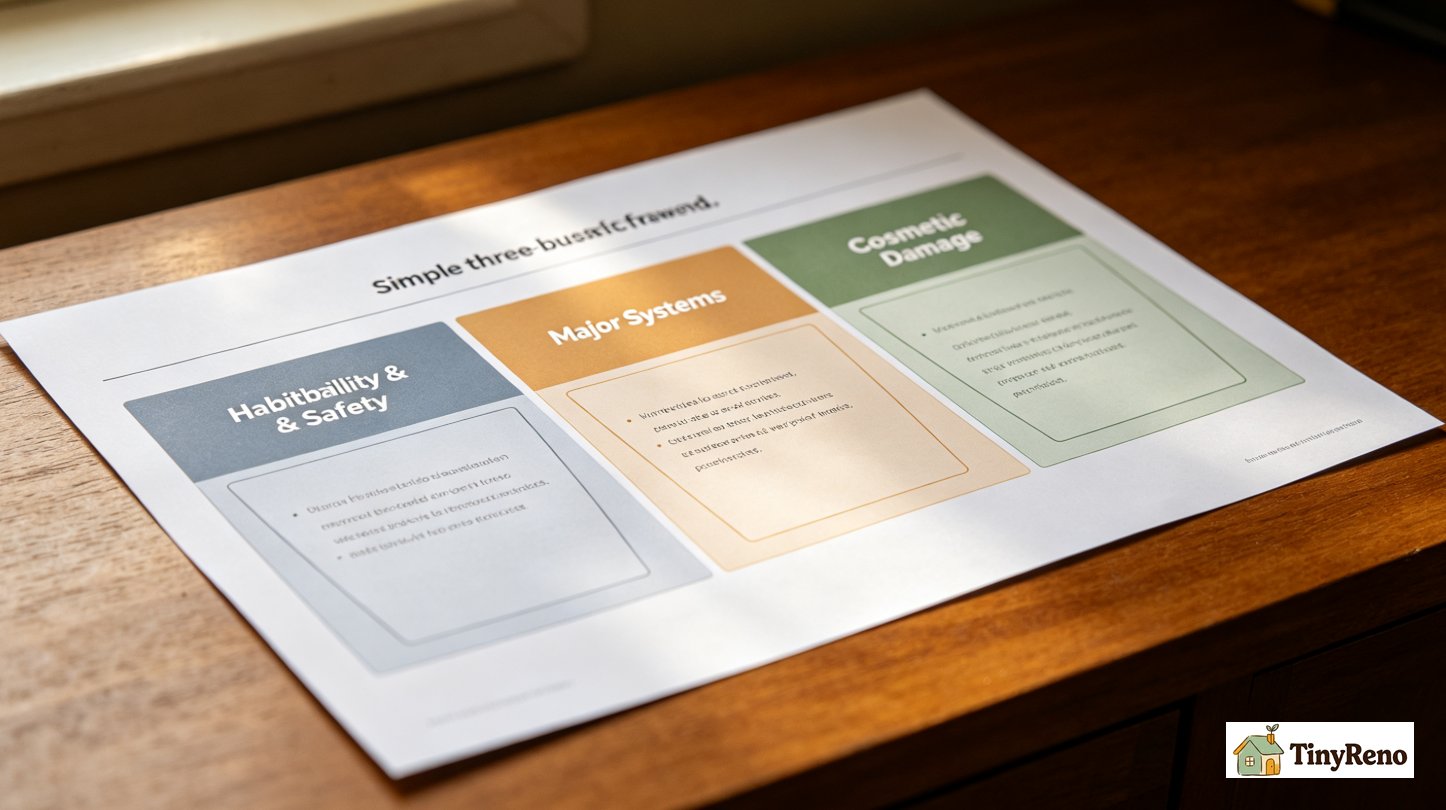
Bucket 1: Habitability and Safety (24-Hour to 14-Day Timeline)
Bucket 1 items are the things that affect whether the apartment is safe and livable. Every state with a habitability statute covers these items. The exact list varies, but the core is consistent.
Heat: The landlord must provide heating capable of maintaining a minimum temperature (typically 65 to 70°F in winter, depending on the state). In states with cold winters (Massachusetts, New York, Minnesota), the requirement is enforced more strictly than in warm-weather states.
Hot water: The landlord must provide hot water capable of reaching 120°F at the tap. Hot water failure is a Bucket 1 item in every state because it affects hygiene and basic living standards.
Plumbing: The plumbing system must deliver running water and remove wastewater. Active leaks, sewage backups, and complete loss of water are Bucket 1. Slow drains are typically Bucket 2.
Weatherproofing: The roof, walls, windows, and doors must prevent water and air infiltration. Active leaks, holes in the roof, broken windows, and failed seals are Bucket 1. Drafts from old windows are typically Bucket 2.
Structural integrity: Walls, floors, ceilings, and stairs must be structurally sound. Major cracks, sagging floors, falling ceilings, and unsafe stairs are Bucket 1. Minor cosmetic cracks are typically Bucket 3.
Smoke and CO detectors: The landlord must provide working smoke detectors in every bedroom and on every level, and CO detectors where required by state law. Failed detectors are Bucket 1, especially for CO.
Locks and security: Exterior doors must have working locks. Windows above the ground floor must have functional latches. Broken locks or windows that cannot close are Bucket 1. Loose doorknobs are typically Bucket 2 or 3.
Electrical: The electrical system must deliver power safely. Exposed wiring, sparking outlets, dead circuits, and electrical fire risk are Bucket 1. A single dead outlet in an otherwise functional room is typically Bucket 2.
Vermin and pest infestation: Most states require landlords to maintain a vermin-free unit. Active infestation (rats, roaches, bed bugs) is Bucket 1. Occasional pest sighting is Bucket 2.
Toxic substances: Lead paint (in pre-1978 buildings), asbestos (in older buildings), and mold that affects habitability are Bucket 1. Small areas of surface mold that can be cleaned with household products are typically Bucket 2.
The bucket 1 timeline is short because these items affect whether the unit is safe to live in. Most states give the landlord 24 to 72 hours for true emergencies (no heat in freezing weather, gas leak, electrical fire risk) and 14 days for serious but not emergency items.
Bucket 2: Major Systems and Appliances (14 to 30-Day Timeline)
Bucket 2 items are the things that make the unit functional and comfortable but do not affect safety or basic habitability. The landlord must repair these within a reasonable time, but "reasonable" is interpreted as 14 to 30 days.
Provided appliances: Refrigerator, stove, oven, dishwasher, microwave (if provided), garbage disposal, washer, dryer (if provided). The exact list depends on what was in the unit at move-in. A broken refrigerator in summer is closer to Bucket 1 because of food safety. A broken dishwasher is squarely Bucket 2.
HVAC system: Central air, central heat, window units provided by the landlord. Bucket 2 if the failure is gradual (AC takes longer to cool, heat takes longer to warm). Bucket 1 if the failure is complete (no AC in extreme heat, no heat in freezing weather).
Hot water heater: Functional issues (water takes longer to heat, water not as hot as it used to be) are Bucket 2. Complete failure or leaking tank is Bucket 1.
Carpets: Stains, wear patterns, and aging are Bucket 2. The landlord is not required to replace carpet that has worn from normal use, but is required to clean or replace carpet that is unsanitary (mold, pet stains from previous tenant).
Paint: Faded, scuffed, or aging paint is Bucket 3 in most states. Active peeling that affects habitability (lead paint exposure risk) is Bucket 1. Bucket 2 rarely applies to paint.
Cabinets, countertops, drawers: Functional issues (broken hinge, loose handle, drawer that won't open) are typically Bucket 3 (cosmetic). Cabinet structural failure or missing cabinet that affects functionality is Bucket 2.
Windows: Broken seals causing fogging or drafts are Bucket 2. Windows that won't open or close, or that have cracked glass, are typically closer to Bucket 1.
Doors: Interior doors that stick or don't latch are typically Bucket 2 or 3. Exterior doors with security implications are Bucket 1.
The Bucket 2 timeline is 14 to 30 days because the items do not affect safety or basic livability in the short term. A broken dishwasher is inconvenient; it is not dangerous. Most landlords will fix Bucket 2 items within 14 days if requested in writing. The exceptions are landlords who are slow to respond or who dispute tenant responsibility.
Bucket 3: Cosmetic and Tenant-Caused (No Legal Requirement)
Bucket 3 items are the things that look bad, wear out, or get damaged through normal use. The landlord is generally not legally required to repair these. The tenant is typically responsible for the cost or the work.
Loose cabinet hinges and drawer pulls: Cosmetic wear. The tenant can often fix these with a screwdriver in 10 minutes. The landlord is not legally required to repair.
Scuffed paint: Normal wear. The tenant cannot require the landlord to repaint for cosmetic scuffs. The landlord may repaint between tenants as part of turnover.
Worn carpet in high-traffic areas: Normal wear. The landlord is not required to replace carpet that has worn from years of use. The landlord may replace carpet between tenants.
Small nail holes in walls: Normal wear. Most leases explicitly put these on the tenant at move-out. Some landlords will spackle and paint on request; many will not.
Worn doorknobs and handles: Cosmetic. The tenant can replace these with a screwdriver for $5 to $20. The landlord is not required to repair.
Loose tile grout in non-wet areas: Cosmetic. Bucket 1 if water is infiltrating and causing structural damage. Bucket 3 if it is purely cosmetic.
Tenant-caused damage: Holes larger than a picture nail, stains from spills, broken fixtures from misuse, pet damage. These are the tenant's responsibility per the lease. The landlord can charge for the repair at move-out.
Bucket 3 is the bucket where most tenant disputes go wrong. Tenants assume the landlord will fix anything broken in the unit. The landlord is only legally required to fix items in Bucket 1 and Bucket 2. Items in Bucket 3 are either tenant responsibility or normal wear that the landlord addresses at turnover.
The practical implication: before sending a repair request, classify the item. If it is Bucket 3, you can ask, but the landlord can legally decline. If it is Bucket 1 or Bucket 2, the landlord must respond within the legal timeline, and you have escalation rights if they do not.
The Decision Tree (which one do you have)
The 3-bucket decision tree is short. Run any repair item through it:
Step 1: Is anyone in danger?
If yes — Bucket 1. Gas leak, electrical fire risk, no heat in freezing weather, broken exterior lock, no water, sewage backup, mold causing health symptoms. Repair timeline: 24 to 72 hours. Consequence of non-repair: code enforcement, AG complaint, lease termination possible.
If no — go to step 2.
Step 2: Can the unit be lived in safely and at basic comfort without the repair?
If no — Bucket 1. Major plumbing failure, weatherproofing failure, no hot water, complete HVAC failure in extreme weather. Repair timeline: 7 to 14 days. Consequence of non-repair: code enforcement, AG complaint.
If yes — go to step 3.
Step 3: Is the item a major system, provided appliance, or habitability support?
If yes — Bucket 2. Refrigerator, dishwasher, HVAC, water heater, drafty windows, slow drains, faulty electrical outlet (not sparking). Repair timeline: 14 to 30 days. Consequence of non-repair: written follow-up, code enforcement if safety-adjacent.
If no — go to step 4.
Step 4: Is the damage tenant-caused or pure cosmetic wear?
If yes — Bucket 3. Loose cabinet hinge, scuffed paint, worn carpet, small nail holes. No legal requirement for landlord to repair. Tenant responsible or request as courtesy.
The decision tree takes 30 seconds. Running it before sending the repair request prevents the awkward conversation of asking the landlord to fix something they are not legally required to fix, and prevents the worse conversation of failing to ask for something they are legally required to fix within the legal timeline.
What to Do Once You've Identified Your Bucket
Once you know the bucket, the request template and timeline are straightforward.
For Bucket 1 items: Send the written request within 24 hours of noticing the problem. Set a 24 to 72-hour deadline for emergency items, 14 days for serious-but-not-emergency. If the landlord does not respond, escalate immediately to code enforcement. Bucket 1 items justify the strongest escalation.
For Bucket 2 items: Send the written request with a 14-day deadline. If the landlord responds with a scheduled repair time, accept it. If the landlord does not respond, send a follow-up after 14 days, then escalate after 21 days.
For Bucket 3 items: You can ask, but be clear in the request that you understand the landlord is not legally required to repair. Some landlords will fix Bucket 3 items as a courtesy to keep good tenants. Some will not. Either response is legal.
The bucket also affects the escalation path. Bucket 1 items can be escalated to code enforcement within days. Bucket 2 items typically go through written follow-up first. Bucket 3 items do not escalate to legal action because there is no legal violation.
Before escalating to code enforcement, check whether your city has a tenant union or nonprofit housing counselor. They can review your case for free, help you draft a stronger escalation letter, and sometimes contact the landlord directly on your behalf. A letter from a tenant union often carries more weight than a letter from an individual tenant. Search "[your city] tenant union" or "[your city] housing counselor."
Bucket Lookup Table: Common Repair Items
The table below maps the 3 buckets to the most common repair items in each state. Where a state treats an item differently from the bucket default, the table shows the exception.
Note: This table covers the most common items. The full statute in your state may have additional categories. For the complete statute, your state attorney general's website has the citation.
Heat (Bucket 1 in states with habitability statutes): California, New York, Massachusetts, Texas, Florida, Illinois, Pennsylvania, Ohio, Georgia, North Carolina, Michigan, New Jersey, Virginia, Washington, Arizona, Minnesota, Wisconsin, Colorado, Oregon, and most other states.
Hot water (Bucket 1 in states with habitability statutes): Same as heat.
Plumbing leaks: Bucket 1 if active leak or sewage. Bucket 2 if slow drain or dripping. Bucket 1 in California, New York, Texas, Florida, all states.
Appliances (provided with unit): Bucket 2 in all states for refrigerator, stove, oven, dishwasher, garbage disposal. Bucket 1 if refrigerator fails in summer and food safety is at risk (varies by state).
HVAC: Bucket 1 in extreme weather if complete failure. Bucket 2 in mild weather or partial failure. All states.
Windows: Bucket 1 if broken glass or cannot close. Bucket 2 if drafty or fogged. All states.
Smoke detectors: Bucket 1 in states with habitability statutes. Most states require working detectors at move-in. Failure after move-in is landlord responsibility for hardware, tenant responsibility for batteries (varies).
Locks (exterior): Bucket 1 in most states. Security-related.
Carpets: Bucket 2 if unsanitary or unsafe. Bucket 3 if worn or stained. Most states allow normal wear at move-out without charge.
Paint: Bucket 3 unless lead paint, peeling that exposes hazards, or unsanitary conditions. Most states.
Cabinet hardware: Bucket 3 unless structural failure. Most states.
Pest infestation: Bucket 1 in most states. Tenant responsibility if infestation is caused by tenant's actions (poor sanitation, etc.).
Mold: Bucket 1 if affecting habitability or health. Bucket 2 if minor and cleanable. Some states (California, New York) have specific mold disclosure and remediation requirements.
This table covers common items under most state statutes. Some states have specific exceptions—for example, California and New York have detailed mold remediation rules. Check your state's statute for the exact classification. Specific edge cases follow the same logic: safety and habitability are Bucket 1, function is Bucket 2, cosmetic is Bucket 3.
The Request That Wins Disputes
The repair request that wins disputes follows a specific template. The template differs by bucket.
For Bucket 1 items:
Subject: Emergency repair request, [unit number], [item]
Body: This is an emergency repair request. The [item] in my unit has [specific problem]. This affects [habitability / safety]. Per [state] habitability law and lease Section [X], I am requesting immediate repair, no later than [24-72 hours]. I am available for access at [specific times]. Please confirm receipt and timeline.
For Bucket 2 items:
Subject: Repair request, [unit number], [item]
Body: I am writing to request repair of the [item] in my unit. The [problem] has been ongoing since [date]. Per [state] habitability law and lease Section [X], I am requesting repair within 14 days. I am available for access at [specific times]. Please confirm receipt and timeline.
For Bucket 3 items (as courtesy request):
Subject: Courtesy request, [unit number], [item]
Body: I am writing to ask about the [item] in my unit. I understand this may not be a landlord responsibility, but I wanted to ask if you would be willing to [specific request]. If not, I can handle it myself. Thank you for considering.
The bucket sets the tone—urgent, routine, or courtesy—and the deadline. When your request matches the bucket, the landlord immediately understands the legal weight, which gets faster results.
If Your Repair Is Being Refused (Recover What You Can)
If the landlord has refused a Bucket 1 or Bucket 2 repair, four moves are still open.
Move 1: Send the second written notice with state law citation. Most landlords respond when the notice names the specific statute. The second notice is also your evidence for the next steps.
Move 2: Contact code enforcement. For Bucket 1 items, code enforcement has authority to require the repair. The complaint is usually free. The inspector's letter to the landlord typically produces a response within days.
Move 3: Withhold rent or break the lease where state law permits. This is high-risk—getting it wrong can lead to eviction. Most states require you to put withheld rent in an escrow account, give written notice, and wait a specific period. Never withhold rent without checking your state's exact procedure first.
Move 4: Small claims court. Filing fee $30 to $75. You do not need a lawyer. The bucket classification, the repair request, and the landlord's refusal or non-response is your case.
What to skip if your repair is being refused: arguing the bucket classification with the landlord. The state statute determines the bucket, not the landlord's opinion. State your bucket, cite the statute, and escalate.
The Short Version (If You're Skim-Reading)
What is a landlord legally required to repair in most states? Habitability items (heat, hot water, weatherproofing, plumbing), safety items (smoke detectors, locks, structural integrity), and major systems and appliances. Cosmetic items and tenant-caused damage are usually not legally required repairs.
Are landlord repair responsibilities state by state different? The bucket categories are consistent across states, but the specific items in each bucket vary slightly. The 50-state lookup table above shows which bucket each common item falls into in each state. Knowing your bucket is the framework that decides which disputes you can win.
How fast must the landlord repair habitability issues? 24 to 72 hours for true emergencies, 14 days for serious items. Cosmetic issues have no legal deadline because there is no legal requirement to repair them.
Can a landlord refuse to repair something I broke? Yes. Tenant-caused damage is typically the tenant's responsibility per the lease. The landlord can charge for the repair or do the repair and bill the tenant.
What's the fastest way to get a repair done? Classify the item by bucket, send the appropriate request with the matching deadline, offer specific access times, and follow up in writing at the deadline. The bucket classification makes the request feel legally grounded, which gets faster results.
The body of this article walks through the items in each bucket, the decision tree for classifying repairs, and the request templates that match each bucket. The 3-bucket rule is the framework that decides which disputes you can win and which you have to negotiate as a courtesy.


Discussion (0)
Sign in to join the discussion