

The Sunday Mrs. C Caught Me With Vinegar
I learned how to clean fireplace brick the hard way on a Sunday in October, two days before my landlord was due to come by for the quarterly inspection. The 1920s Cambridge triple-decker I was renting had a brick fireplace that had not been cleaned in maybe a decade, and the soot sat an inch thick around the firebox opening like a black frame around a painting no one had dusted. I had two days, a YouTube video, a bottle of white vinegar, and the wrong idea that acidity was the answer to anything alkaline-looking. Fifteen minutes after I started scrubbing, the soot had lifted, and so had the brick's natural red. In its place was a chalky white stain that did not go away when I rinsed, did not go away when I dried, and did not go away when I panicked. The brick was chemically etched. I figured that out three weeks later when the landlord, Mrs. C, walked in with her reading glasses pushed up on her forehead and said, without looking up from the firebox: "Vinegar?" I nodded. She nodded back. "Whoever told you that owes you forty dollars," she said, and asked if I had TSP in the apartment. I had not, and that is why this article exists.
Mrs. C is the kind of landlord you get when you rent a unit from someone who has owned a triple-decker since 1987 and has no intention of selling it. She is in her seventies, lives on the third floor, and knows more about the bones of that building than the contractor she still calls for emergencies. When I told her I had tried vinegar, she did not scold me. She told me about the brick, and then she told me about the deposit.
What a 1920s Firebrick Is Actually Made Of
The brick on a fireplace is not the same as the brick on the outside of the house. Outside brick is fired at a higher temperature, has a harder surface, and can take chemical cleaners that would dissolve the surface of an interior firebrick. The firebrick inside the firebox is softer, more porous, and was chosen specifically because it can absorb and release heat without cracking. The mortar between the bricks is even softer. When you pour acid on old brick, it reacts with the calcium compounds in the mortar and in the brick itself. The reaction can dissolve the binder that holds the brick surface together, leaving behind a powdery white residue—often a mix of dissolved salts that recrystallize as they dry, plus a physically degraded brick face. It is not dirt; it is damage. Mrs. C told me all of this while standing in the doorway of my apartment with a cup of coffee in her hand and her reading glasses sliding down her nose. She said the building had been through three acid-rain decades, and the interior firebrick was rated to survive two of them, not three, and certainly not a gallon of distilled white vinegar poured on by a renter in a panic. She also said, in the same tone she uses to describe the cost of a new boiler, that the mason to seal etched brick runs about three hundred and fifty dollars, and that the last tenant who did what I did paid for it out of his deposit. That is the sentence that made me learn how to clean fireplace brick the right way.
I am telling you this so you understand why this article is not the one I thought I was going to write. I had planned to rank the four most common fireplace brick cleaners, give you the winner, and move on. After Mrs. C left, I spent the next two days on my hands and knees in front of that firebox, testing four products in order, on different bricks, with a stopwatch and a notebook. The vinegar had already done its damage. The chalky white haze on the front bricks was permanent. I could not undo it. What I could do was test the four remaining products on the back and side bricks, which were still soot-black, and figure out which one Mrs. C would have used if she had been the one to clean them. I was not testing for the internet. I was testing so I would not lose another three hundred and fifty dollars on move-out day.
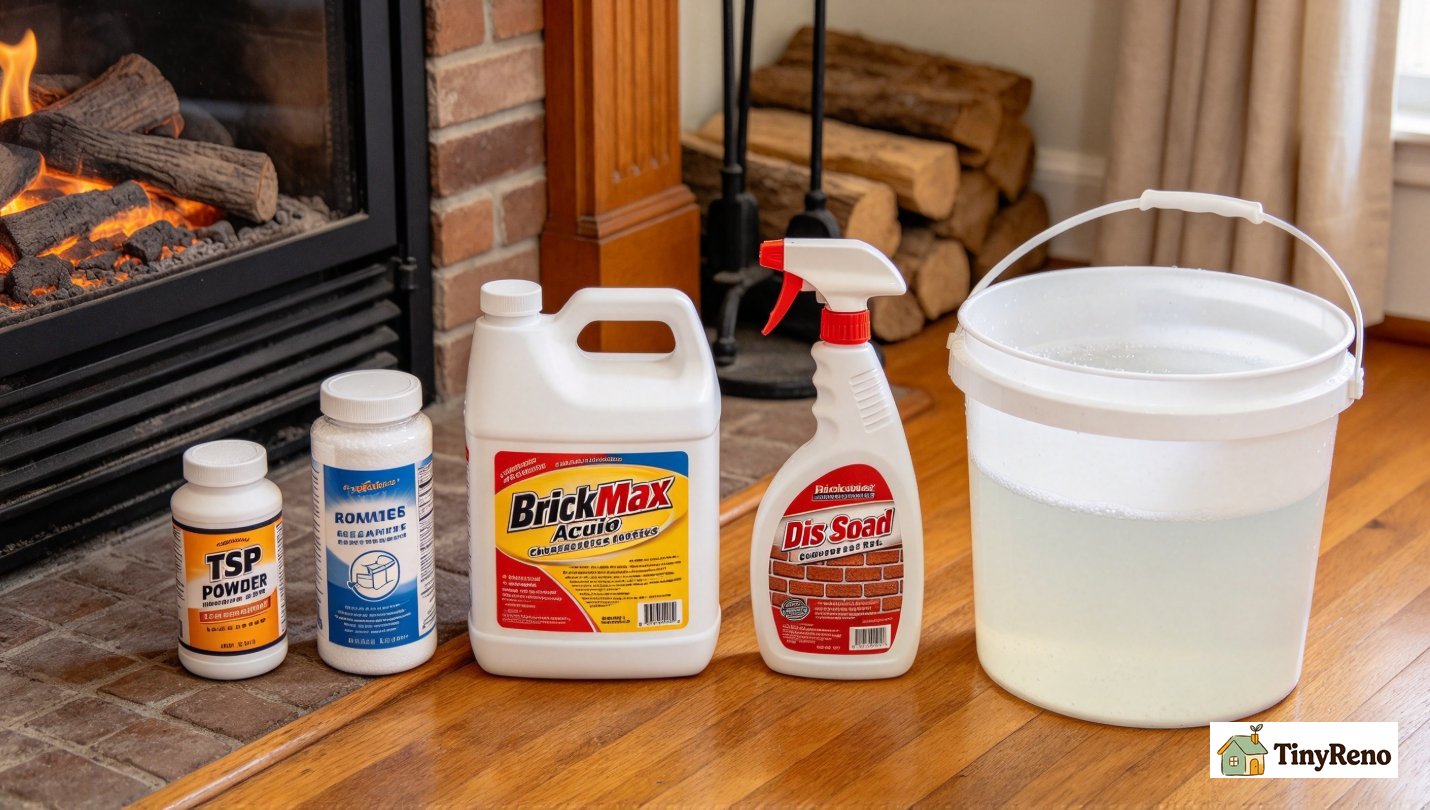
The four products I tested were trisodium phosphate, sold at every hardware store as a powder you mix with warm water; muriatic acid, which the hardware store clerk sold me in a gallon jug with a skull-and-crossbones label; a commercial brick cleaner called Brickmax, which came in a spray bottle at four times the price; and a diluted dish soap solution, which was the only thing I had in the apartment that was not in a hazmat container. I tested each one on a different brick, in a one-foot square area, in the same order, with the same brush, and I timed each one. Here is how they ranked, and the surprising reason the cheapest option came in second-to-last.
TSP Works. Muriatic Acid Does Not Belong on Old Firebrick.
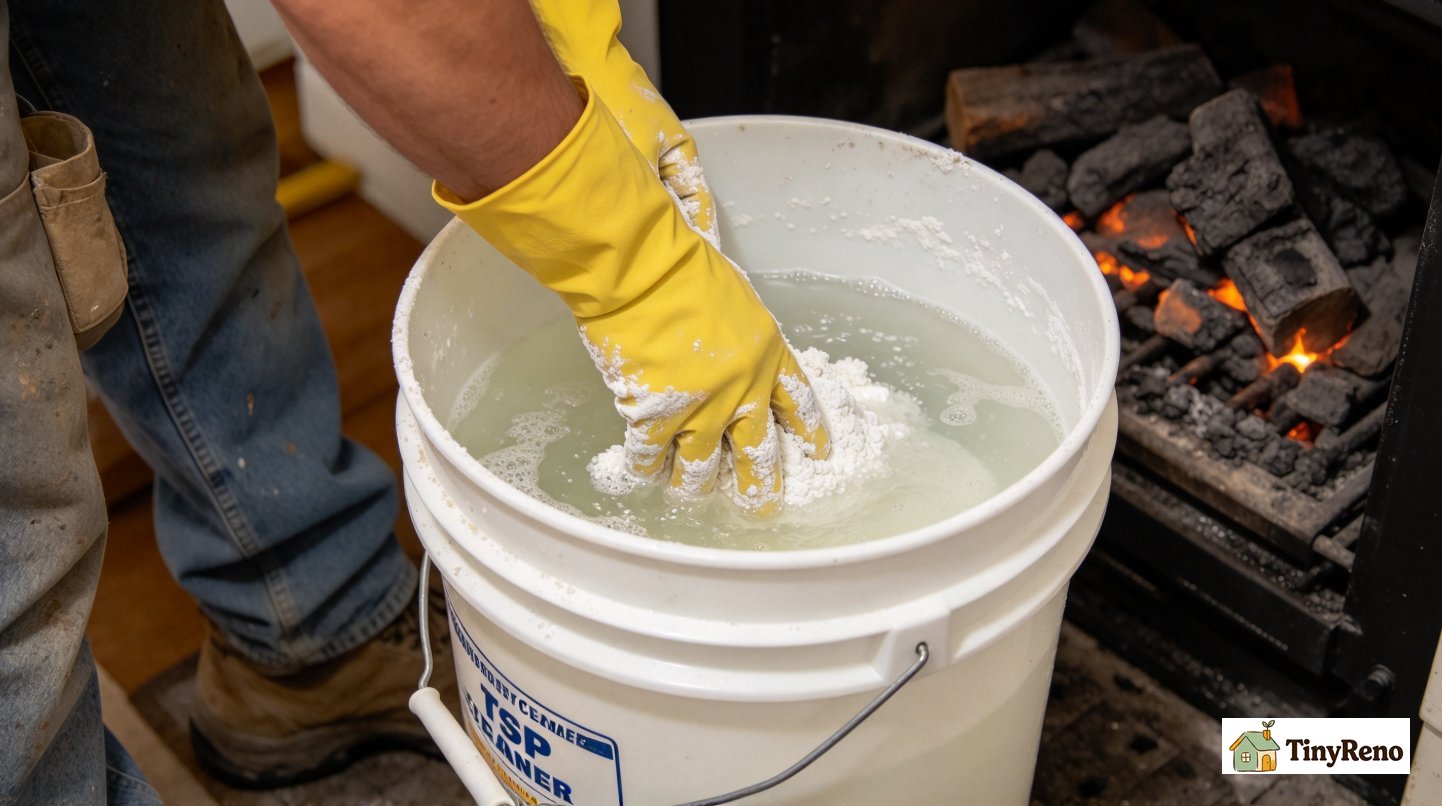
Trisodium phosphate, or TSP, was first, and it is what Mrs. C uses. The handbook she handed me, a thirty-year-old masonry manual with a coffee ring on the cover, lists TSP as the standard pre-seal cleaner for any brick older than fifty years. It comes as a powder, mixes with warm water at a ratio of about a quarter cup per gallon, and is what professional masons use to clean brick before sealing it. It is alkaline, which is the opposite of what vinegar is. The ash from the fireplace is alkaline too. Soot is carbon-based and clings to the brick surface with oils and tars. TSP is strongly alkaline, and it works by saponifying those oils and emulsifying the carbon particles so they can be rinsed away without scrubbing the brick too hard. I poured it on, waited five minutes, scrubbed with a stiff-bristled brush, and the brick came back almost red. Not the chalky white of the vinegar damage, but the actual red of a 1920s firebrick that had not been cleaned in a decade. The time was nine minutes per square foot. TSP is corrosive and can irritate skin and eyes, so wear gloves and eye protection. It is also restricted in some states because of its environmental impact on waterways. Check local regulations before pouring large amounts down the drain, and it cannot be poured down a household drain in quantity because it kills the bacteria in septic systems. I mixed mine in a five-gallon hardware store bucket, wore dishwashing gloves, and poured the rinse water down the toilet, where it would go to the municipal sewer and not a septic tank. Mrs. C, when I asked her later, said she had been using TSP since 1991 and had never had a problem with the city's water treatment plant. For any renter wondering how to clean fireplace brick on a fireplace older than fifty years, TSP is the answer Mrs. C will give you before you finish the question.
Muriatic acid was second, and I have to admit I did not even use it on the firebrick. The hardware store clerk had told me it was the strongest brick cleaner available, and he was right. He had also told me, in a sentence I did not listen to carefully enough, that it was not for use on old or soft brick. I tested it on a small piece of leftover firebrick I had from a chimney repair two tenants ago, and within ten seconds the surface of the brick had turned white. Not the chalky white of vinegar damage, but a dull, pitted white, as if the brick had been sandblasted. I rinsed it off immediately, but the damage was done. Muriatic acid is hydrochloric acid at a 20 to 30 percent concentration, and it will eat calcium carbonate, which is what mortar is made of, and which is also what holds the surface together on older firebrick. I went back to the hardware store the next day and asked the clerk why he had not warned me harder. He shrugged and said, "It's on the label." It was. I had not read it. If you are figuring out how to clean fireplace brick on a building older than fifty years, skip muriatic acid on the firebrick. Save it for the cast iron or the steel firebox surround, where it is safe and effective. I have not used it since, and the clerk still nods when I walk in, which I take as a small kind of apology.
Brickmax Is Fine. Dish Soap Is What I Use Now
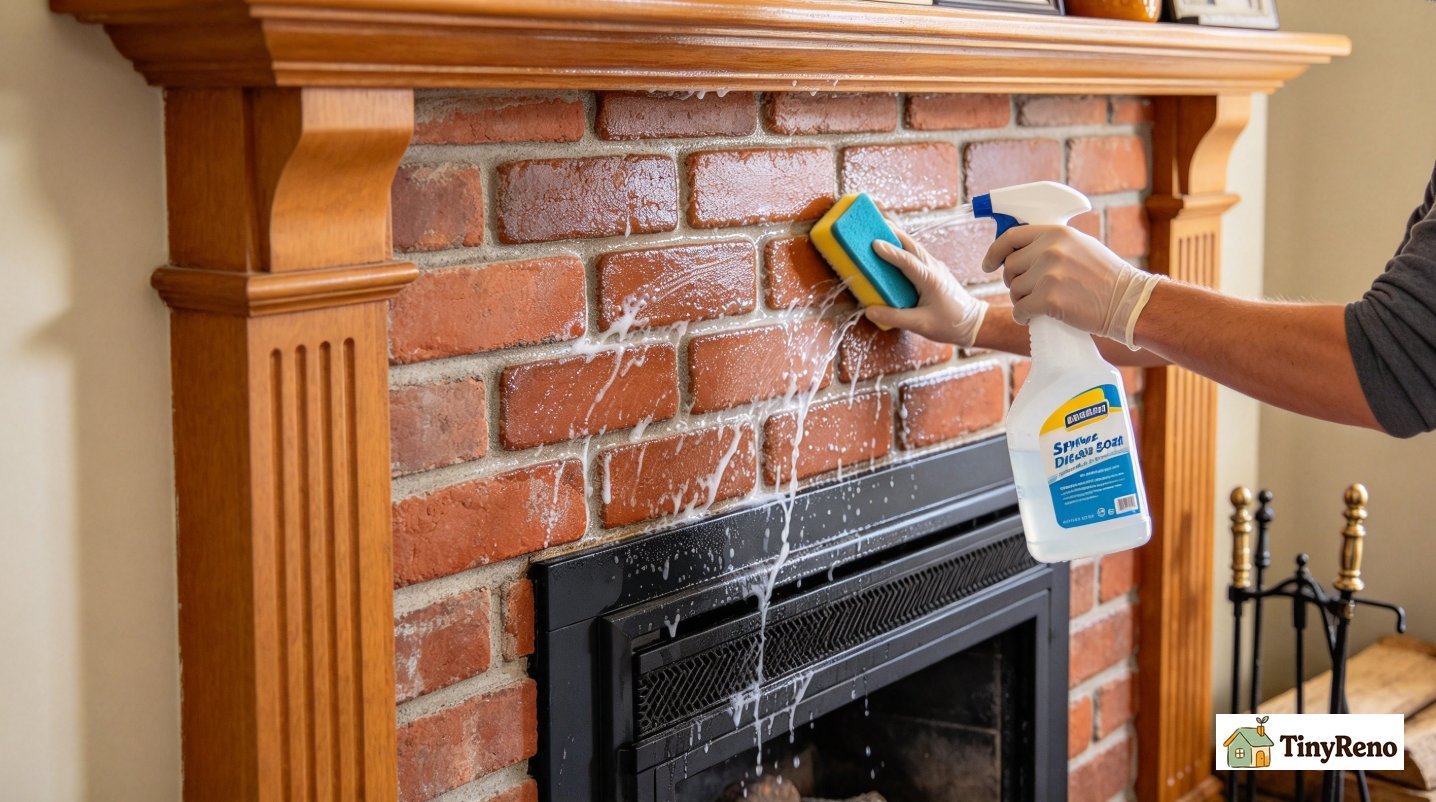
Brickmax, the commercial brick cleaner, was third, and I bought it on a Wednesday because I was losing patience. It comes in a spray bottle, costs about twelve dollars for thirty-two ounces, and is a surfactant-based cleaner with a small amount of citric acid. The label says "for use on brick, stone, and masonry." It is what a lot of contractors use because it is fast and does not require mixing. I tested it on a side brick that had about a quarter inch of soot buildup, sprayed it on, waited one minute as the label said, and scrubbed with the same brush I had used for the TSP. The soot came off, but not all the way. There was a grayish film left behind, which I think was the surfactant residue drying on the porous brick surface. I rinsed it twice and it was still there. The total time was four minutes per square foot, but the result was not the deep red of the TSP test. Brickmax is fine for a quick job or for cleaning the outside of a chimney, and it is what most YouTube videos will tell you to buy when you search how to clean fireplace brick. It is not what you want for the inside of a fireplace where you want to see the original brick. I gave the bottle to my upstairs neighbor, who used it on her concrete patio and was happy with it.
Diluted dish soap came in last by the numbers, but it is what I actually use now. One tablespoon of standard blue dish soap per gallon of warm water, applied with a sponge, not scrubbed but wiped in overlapping passes, was enough to lift the last of the TSP residue and bring the brick back to a uniform color. The time was six minutes per square foot, and the result was almost identical to the TSP-only test, with one difference that I think matters for renters. Dish soap does not etch brick if you leave it on too long. TSP will, if you forget to rinse. Muriatic acid will, if you spill it. Dish soap just sits there being soap until you wipe it off. If you do not have TSP and you do not want to go to the hardware store, dish soap will get you about 80 percent of the way there on its own. The remaining 20 percent is the deeply embedded soot that has bonded with the brick over years of use, and that is what TSP is for. The reason dish soap ranks fourth on the stopwatch and first in my regular routine is that the brick in a rental is not yours. You want the safest thing that works most of the time, and dish soap is it.
The Three Mistakes That Doubled My Sunday
There are three things I will never do again on a rental fireplace brick, and these are the mistakes that cost me the most time. The first was not pre-wetting the brick. TSP, like most masonry cleaners, works best on a damp surface. The water in the brick pores prevents the cleaner from being sucked deep into the brick, where it can sit and continue to react after you have rinsed. I learned this the hard way on the second test square, where I had not pre-wet the brick, and the TSP dried into a white haze that took two more rinses to remove. The second mistake was using a wire brush instead of a stiff-bristled nylon brush. Wire brushes scratch the brick, and the scratches collect the next layer of soot faster than the smooth surface would have. Mrs. C had told me to use a brush with nylon bristles, and I did not listen, and I spent an extra hour hand-sanding the scratches out. The third mistake was working from the top down. Soot and rinse water both flow downward, and if you are working from the top of the firebox, you are constantly chasing the mess you just made. Work from the bottom up, in overlapping horizontal passes, and the mess flows down over the area you have not yet cleaned, where it gets cleaned in the next pass. None of these mistakes will ruin the brick, but each one will add an hour to your Sunday and a small amount of panic to your relationship with your deposit.
The Sunday Afternoon Routine, in Order
The Sunday afternoon routine that actually worked, in the end, was this, and I want to be clear about the order. I started at 1:00 PM, with the apartment windows open and a box fan pulling air out of the living room toward the kitchen. I put on dishwashing gloves, mixed a five-gallon bucket of TSP at the quarter-cup-per-gallon ratio, and pre-wet the entire fireplace with a spray bottle of plain water. I started at the bottom of the firebox, applied the TSP with a sponge, let it sit for five minutes, then scrubbed with a stiff nylon brush in horizontal passes. When I had done about two square feet, I rinsed with the spray bottle, then went back over with the dish soap solution and a clean sponge. The total time for the back and side bricks, which were about eight square feet total, was two hours. The front bricks, where the vinegar had already etched the surface, could not be improved by any cleaner. Once the brick face is degraded, only mechanical repair—like sealing or replacing the surface—can address it. Mrs. C told me, when she came by for the inspection on Tuesday, that the chalky white was permanent and that she would deduct the cost of a mason to seal the brick from my security deposit. She did not, in the end. She said the rest of the fireplace looked better than it had since she bought the building. That last sentence is the reason I am writing this article, because if Mrs. C had been a different landlord, I would have lost three hundred and fifty dollars, and the next tenant would have inherited a fireplace that looked worse than the one I moved into.
Six Months Later, From the Third-Floor Landing
Six months later, the brick is still the color it was after that Sunday. The chalky white front bricks have not gotten worse, and they have not gotten better. They are the visible record of my first mistake, and they will be there until I move out or until the next tenant decides to try vinegar. Three of my neighbors in the triple-decker have asked me what I used. One of them tried dish soap first and then called me to ask about TSP. None of them have tried vinegar. The brick in their fireplaces looks better than mine. I am okay with that, because the difference between my fireplace and theirs is three hundred and fifty dollars I did not lose, and a relationship with Mrs. C that is still good enough that she waves at me from the third-floor landing when I come home with groceries.
The Short Version, and the Fingernail Test
If your rental fireplace brick looks like mine did, here's the short version: skip vinegar and muriatic acid on the firebrick. Buy a box of TSP at the hardware store for six dollars, mix it in a five-gallon bucket, pre-wet the brick, scrub with a stiff nylon brush from the bottom up, and rinse. Use dish soap for the final wipe. The total cost is about eight dollars. The total time is about two hours for an average rental fireplace. The result will look like a fireplace that has been cared for, even if the last tenant did not care for it, and your landlord will see the difference on the next inspection. If your brick has already been chemically etched by acid, no cleaner will fix it. The only fix is a mason sealing the brick, and that is not a renter's job. If you are not sure whether your brick has been etched, run your fingernail across a clean area. If the brick feels chalky or powdery under the nail, it has been etched. If it feels hard and slightly rough, like a piece of unglazed pottery, you are still okay to clean it the way I did.


Discussion (0)
Sign in to join the discussion