

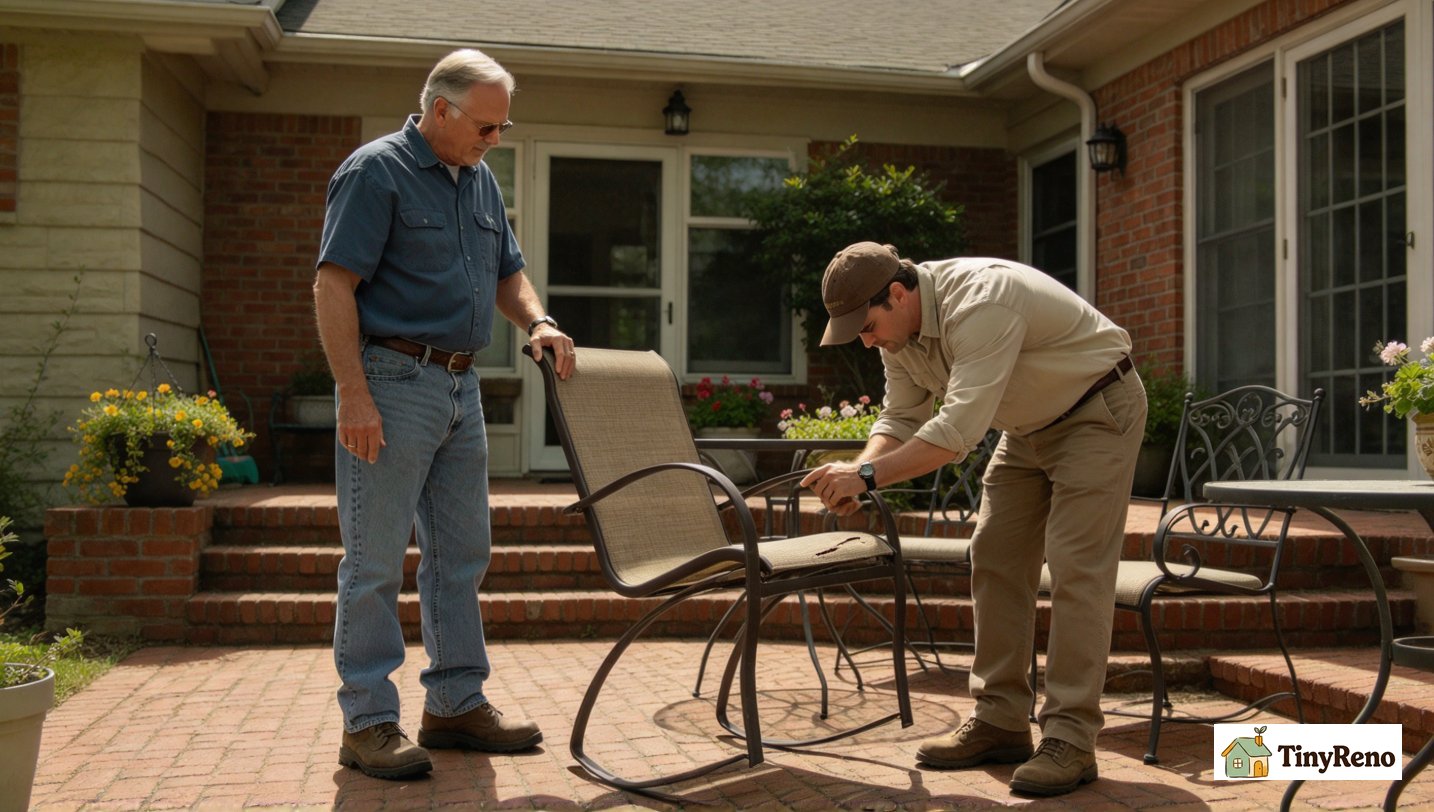
I learned what patio chair replacement parts look like when they have failed on a Tuesday in November, when I was sitting at the kitchen table with my partner and three patio chair parts in front of us, and the parts were a foot cap that had snapped at the bottom of the leg, a screw that had corroded in half and was sitting on the drop cloth like a dead bug, and a piece of the seat frame that had bent from a renter who had used the chair as a step stool and that was the kind of bend that was not going to unbend. The three parts were the three parts that the father-in-law in Cleveland had told me about, and the father-in-law had been right about the order in which the parts fail, and the father-in-law had been wrong about which parts the hardware store on Atlantic Avenue was going to have in stock. The hardware store had the foot cap and the screw. The hardware store did not have the seat frame. The seat frame was a part that was going to take four weeks to order from the chair manufacturer, and the four weeks was going to cost me four weeks of one of the four chairs sitting on the patio with a bent frame, and the four weeks was going to cost me four weeks of looking at the bent chair and wondering if I should just buy a new chair for $89 instead of waiting four weeks for a part that was going to cost $24 plus shipping.
The 4 Things Every Renter Has to Weigh About a Broken Chair
The decision I had to make that Tuesday in November is the same decision every renter with four patio chairs eventually faces: replace the part or replace the chair. Four things determine the answer.
First, the age of the chair. How many summers does it have left? You can estimate by looking at the other three chairs and counting the parts that look ready to fail in the next year or two.
Second, the cost of the part. Not just the part in your hand, but the part that will fail next year and the part that will fail the year after that.
Third, the cost of a new chair. The price plus assembly time plus getting rid of the old chair. Renters often assume they can leave the old chair on the patio, but the landlord will challenge that at move-out.
Fourth, whether a new chair will match the other three. If Home Depot no longer sells the 2018 model, the new one will look different on the patio.
How Old the Chair Is, and How Many Summers It Has Left
The chair in front of me was a 2018 Aluminum Frame Patio Chair that I had bought in 2019. By November 2025, the chair was six years old. It had been through six Brooklyn winters and six Brooklyn summers and three moves. It had broken a strap, a foot cap, a screw, and now a piece of the seat frame. The chair had three summers left in it if no more parts broke, and one summer left if one more part broke. The part that was going to break next was the back frame, which takes the weight of the person leaning back. The back frame was already showing the kind of stress the seat frame had shown six months before it bent. The next broken part was not a question of if. It was a question of when, and the when was going to be next summer.
The $39 Part vs the $110 Chair, and Why the New Chair Does Not Match
The part in my hand was the bent seat frame. It cost $24 plus $15 shipping, took four weeks to arrive, and would take me two hours to install. It would last the rest of this summer, next summer, and the summer after that. Total cost: $39 plus my time. A new chair from Home Depot was $89 plus tax and delivery. With assembly time, the total was roughly $110. The new chair would last four to six summers. It would cost $71 more than the part, and it would not match the other three chairs because Home Depot had stopped selling the 2018 model and was selling a 2024 model with a slightly different frame, color, and strap.
Robert, My Neighbor, and the $40 He Did Not Save
The neighbor who came over to look at the chair was a man named Robert who lives on the second floor of my building and who has been renting his apartment for nine years and who has been replacing the parts on his patio furniture for the entire nine years, and Robert told me, when I showed him the bent frame and the foot cap and the screw, that the decision was not the decision I was trying to make, and that the decision was the decision I had made three summers ago when I had bought the chair from Home Depot in the first place instead of buying the chair from a patio furniture store that charged $40 more but that included a ten-year warranty on the frame. Robert's chair had a ten-year warranty on the frame. Robert's chair had been through the same four winters and the same four summers and the same three moves. Robert's chair had not bent. Robert's chair had not broken a frame. Robert's chair had broken the same foot cap and the same screw, but the chair had broken cheap parts that Robert had replaced for $4 in total, and the chair had not broken the expensive part that I had broken, which is the part that the ten-year warranty would have covered, which is the part that the Home Depot chair did not have a warranty for, which is the part that I was now holding in my hand and trying to decide whether to spend $39 on.
I told Robert that the decision I was making now was the decision I had made three summers ago, and that the decision I had made three summers ago was the decision I had to live with now, and that the decision I had made three summers ago was the decision to save $40 on the chair. Robert told me that the $40 was the most expensive $40 I had ever saved, which is the kind of thing that a man who has been replacing the parts on his patio furniture for nine years says to a man who has been replacing the parts on his patio furniture for three months. Robert told me that the $40 would have been the difference between a chair with a ten-year warranty and a chair without a ten-year warranty, and that the $40 would have paid for itself the first time the chair broke a frame, which is the time that the chair broke a frame, which is the time that I was now trying to decide whether to spend $39 on the part or $110 on the new chair.
Why I Replaced the Part Instead of the Chair
I replaced the part. It arrived four weeks later, took two hours to install, and cost $39 plus my time. It will last three more summers. But the next part to break will be the back frame, which will cost another $39. And the part after that will cost another $39. Each repair adds up. The $40 I saved on the original chair is now $39, plus $39, plus $39. Robert was right. The $40 was the most expensive $40 I ever saved.
What Most Articles Get Wrong, and the 3 Categories of Replacement Parts
I am telling you this because the question of which patio chair replacement parts to buy is not the question most articles, or how to videos, are going to answer for you. Most articles are going to assume you are buying a chair from Home Depot, not that you are replacing a part on a chair that you bought from Home Depot three summers ago. Most articles are going to assume the part you need is in stock at the hardware store, not that the part you need is going to take four weeks to arrive from the manufacturer. Most articles are going to assume the chair is going to be replaced by a new chair of the same model, not that the chair is going to be replaced by a new chair of a different model that does not match the other three chairs on the patio.

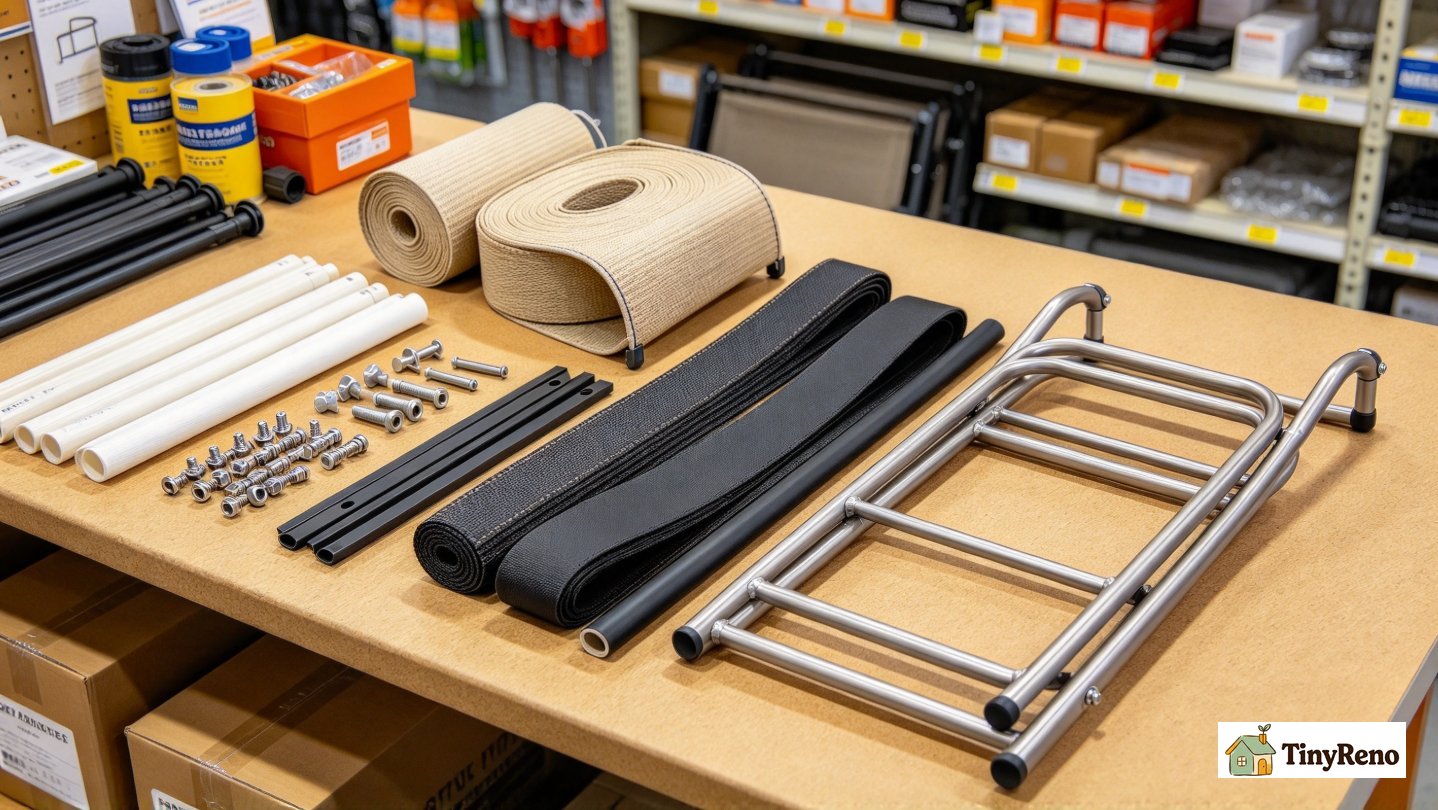
There are three kinds of patio chair replacement parts that a renter is going to need, in the order a renter is going to need them, and the three kinds are the parts that the hardware store has on the shelf, the parts that the hardware store has to order, and the parts that only the manufacturer has. The parts that the hardware store has on the shelf are the foot caps and the screws, and the foot cap costs about $2 and the screw costs about $0.75, and the parts are going to take one trip to the hardware store to replace and the parts are going to last the life of the chair. The parts that the hardware store has to order are the vinyl strapping and the sling fabric, and the strapping costs about $7.99 a foot and the fabric costs about $14 a yard, and the parts are going to take one week to arrive and the parts are going to take one afternoon to install and the parts are going to last five to seven years on a Brooklyn south-facing patio. The parts that only the manufacturer has are the seat frame and the back frame and the leg, and the parts cost between $20 and $40 each plus shipping, and the parts are going to take four weeks to arrive and the parts are going to take two hours to install and the parts are going to last the rest of the life of the chair.
The order you replace parts is the order they fail: strap, foot cap, screw, seat frame, back frame, leg. The strap fails first because it is most exposed to UV. The foot cap fails second because it gets kicked and dragged. The screw fails third because it corrodes. The seat frame fails fourth because it takes weight. The back frame fails fifth because it takes the next most weight. The leg fails last because it is most protected.
Replace them in this order because the cheapest parts fail first and the most expensive parts fail last. The parts that fail last are the ones the manufacturer makes the most profit on—the ones the hardware store does not stock, the ones you cannot substitute, the ones that take four weeks to arrive. If you replace the strap, foot cap, and screw on schedule, you delay the seat frame, back frame, and leg failures. Delaying those failures saves you the $39 plus $40 plus $60 you would otherwise spend on the parts the manufacturer profits most from.
If your patio chair bent and you are deciding whether to replace the part or the chair, here is the short version. Measure the part. Photograph it. Email the photo to the manufacturer. Ask for the part number, the cost, the shipping cost, and the lead time. Ask if it is in stock. Then compare: part cost plus shipping plus your time versus new chair cost plus delivery plus assembly time. Ask whether the new chair will match the other three. Ask what the next part to fail will be. The total cost of parts will eventually exceed the $40 you saved on the original chair. Buy the parts in the order they fail. Buy from the manufacturer before the price goes up. Plan for the next part the way you planned for this one.


Discussion (0)
Sign in to join the discussion