

How to move a mattress by yourself is a question I did not plan to answer. I planned to answer it in 2021, when I moved from a third-floor Bushwick walk-up to a fourth-floor Astoria walk-up with no friends who owned a truck and no money for movers. I planned to answer it on a Saturday morning in May when I stood at the bottom of three flights of stairs in the Bushwick building with a queen mattress leaning against the banister and no idea how to get it up the stairs without dropping it on the landing or on the dog.
I did not plan to answer the question a second time, two years later, when I moved from the Astoria railroad apartment to a one-bedroom in Sunnyside and the queen mattress was the heaviest thing I owned that was not a bookshelf. I did not plan to write this for you. I am writing it because the first time I moved a mattress by myself, I did three things wrong. The second time, I did two of them right. The third time, I did all of them right, and I want to tell you what all of them right looks like, because the answer is not the YouTube answer of "wrap it in plastic and drag it up the stairs." The answer is shorter, cheaper, and it does not get you hurt.
How to move a mattress by yourself depends on the answer to three questions, and the answer to each one decides the method. The first question is how far you are moving. The second question is how many flights of stairs you have to climb. The third question is whether you have a friend, a husband, a boyfriend, a roommate, a sister, a brother, a neighbor, or anyone who can stand at the other end of the mattress for 90 seconds while you walk backwards up three flights of stairs. The third question is the one that decides whether the renter-friendly answer is the answer for you. If you have a friend, the answer is the friend. If you do not have a friend, the answer is below.
The 4 Methods I Tried, and Which 2 Actually Work
Four methods I tried. Two worked. Two I would skip.
Method one was the mattress bag and drag, which is what every blog post tells you to do. You buy a $14 mattress bag at Home Depot, you put the mattress in the bag, you tie the bag shut, and you drag the mattress up the stairs by the bag handles. This method works on flat ground. It does not work on stairs. The bag tears at the seam on the second flight, which is what happened to me in Bushwick. The mattress slid out of the bag, hit the banister, and landed on the landing at an angle. The mattress survived. The drywall did not. I paid $80 for the landlord to patch the corner of the wall I had not meant to hit. Skip the bag-and-drag on stairs. Keep the bag for the truck.
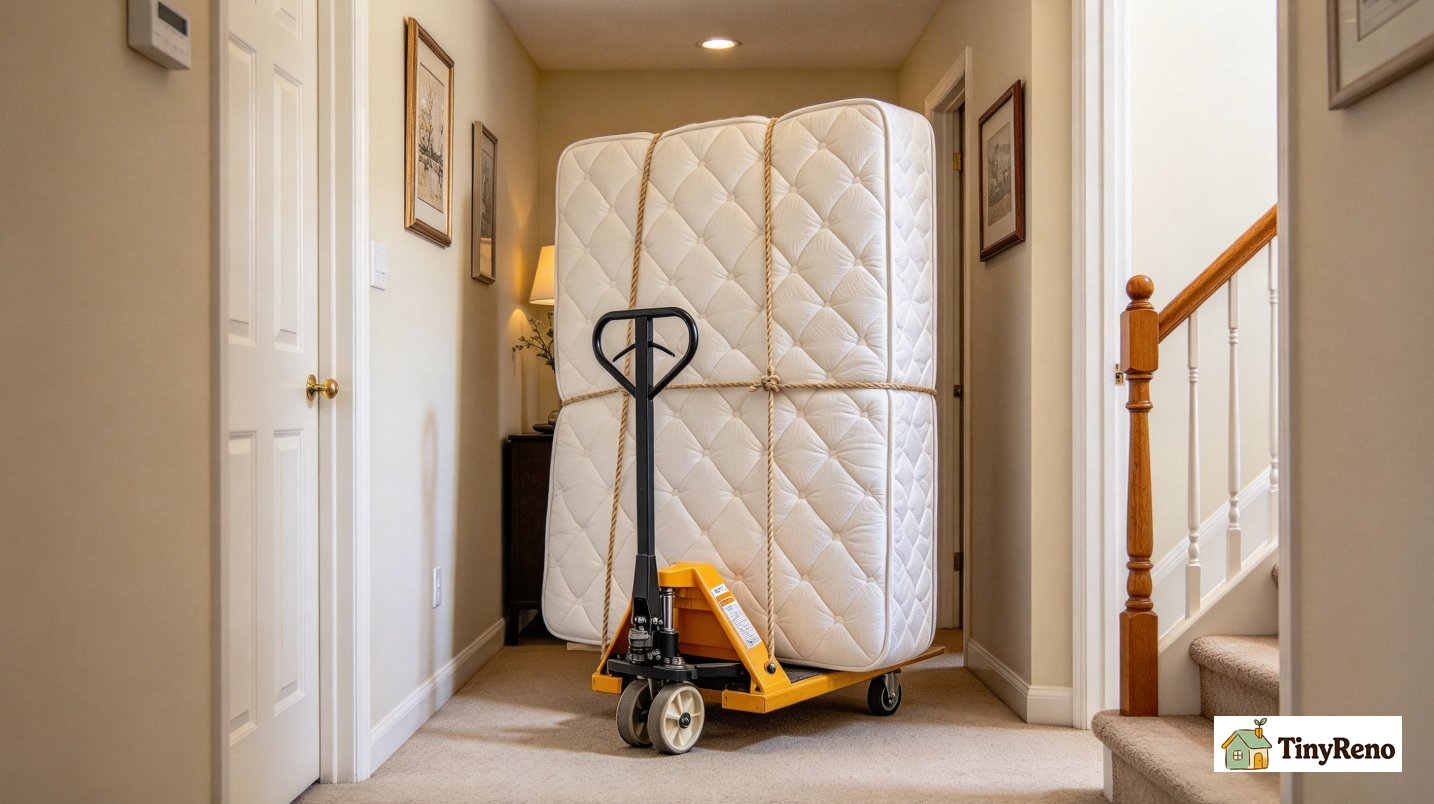
Method two was the ratchet strap and dolly, which is what the moving guys at the Brooklyn U-Haul location told me to do. You rent a furniture dolly from the U-Haul location for $12, you put the mattress on top of the dolly, you ratchet-strap the mattress to the dolly, and you walk the dolly up the stairs. This is the method that works on stairs but only if you have a friend to walk the bottom of the dolly while you walk the top. The dolly alone on stairs is the same problem as the bag and drag. The dolly weighs 28 pounds. The mattress weighs 60 to 80 pounds. The combined weight is too much for one person to control when the stairwell turns at the landing. The dolly method works on flat ground and at the bottom of stairs. The dolly method does not work alone on stairs. Skip the dolly-alone-on-stairs version. Use the dolly for the flat parts of the move, and use method three or four for the stairs.
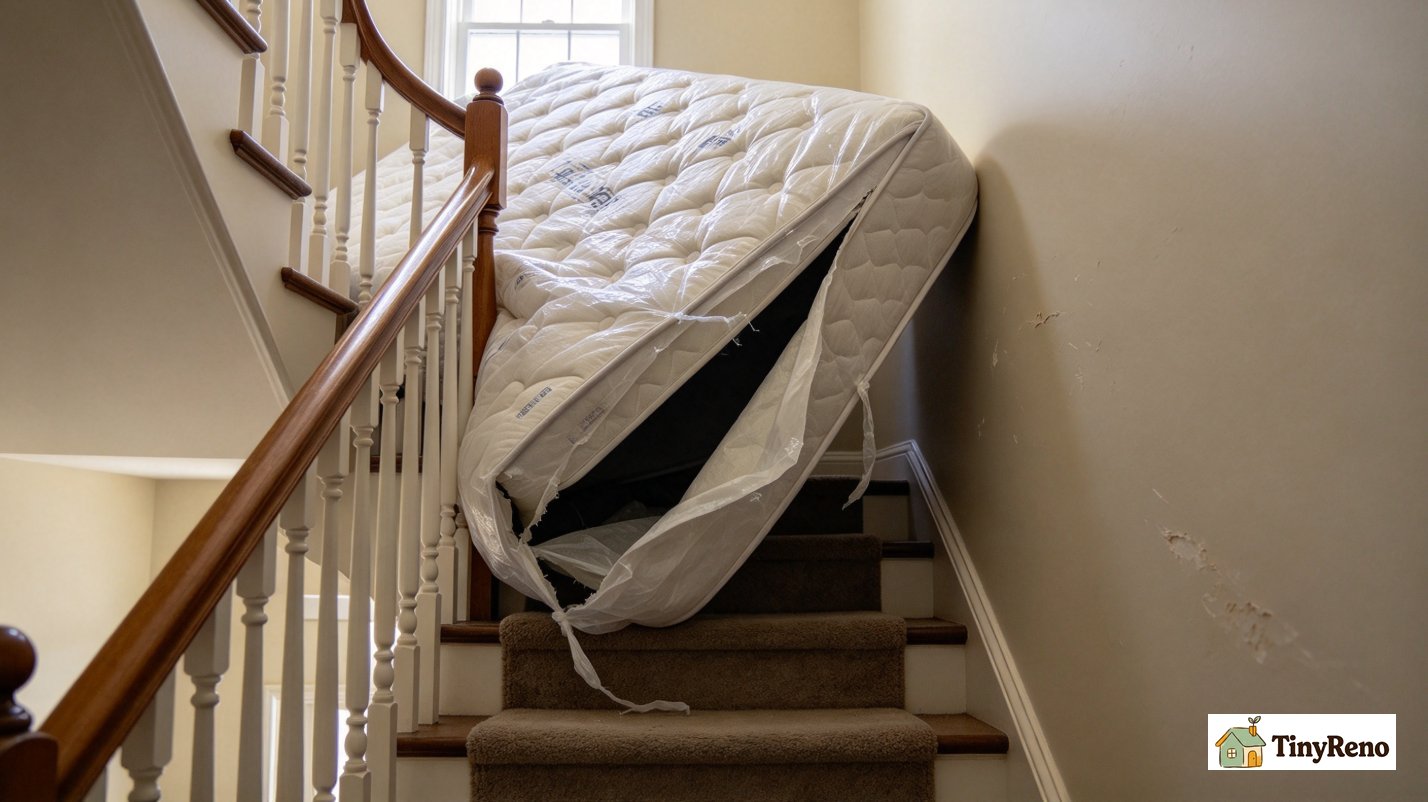
Method three was the mattress-on-shoulder, which my downstairs neighbor in Astoria taught me on a Sunday morning in October 2022. His name was Luis, a 64-year-old retired electrician who came out because he heard me cursing. He told me to fold the mattress in half, pick it up on my shoulder with the fold against my neck, and walk backwards up the stairs. The fold puts the weight on the top of your shoulders and the back of your neck. It keeps the mattress narrow enough to fit through a stairwell turn. It keeps the mattress from hitting the banister or the drywall. It keeps the mattress from sliding out of a bag. The fold-against-the-neck method is the only method I have found that works alone on stairs. I walked a queen mattress up four flights in Sunnyside in November 2024 using this method, alone, in 11 minutes.
Method four was the slide-down-the-stairs, which is what Luis told me not to do and what the YouTube videos say to do. You put the mattress at the top of the stairs, and you let it slide down the stairs, and you walk alongside it to keep it on the carpet. This method tears the mattress cover and bends the springs. The YouTube videos are wrong about this. The YouTube videos are made by people who are not moving down the stairs. The YouTube videos are made by people who are filming themselves moving down the stairs. The two activities are not the same. Skip method four entirely. If you are searching how to move a mattress by yourself, you are already past method four.
The Tools You Need and the 3 to Skip
The 3 tools you need and the 3 you should skip.
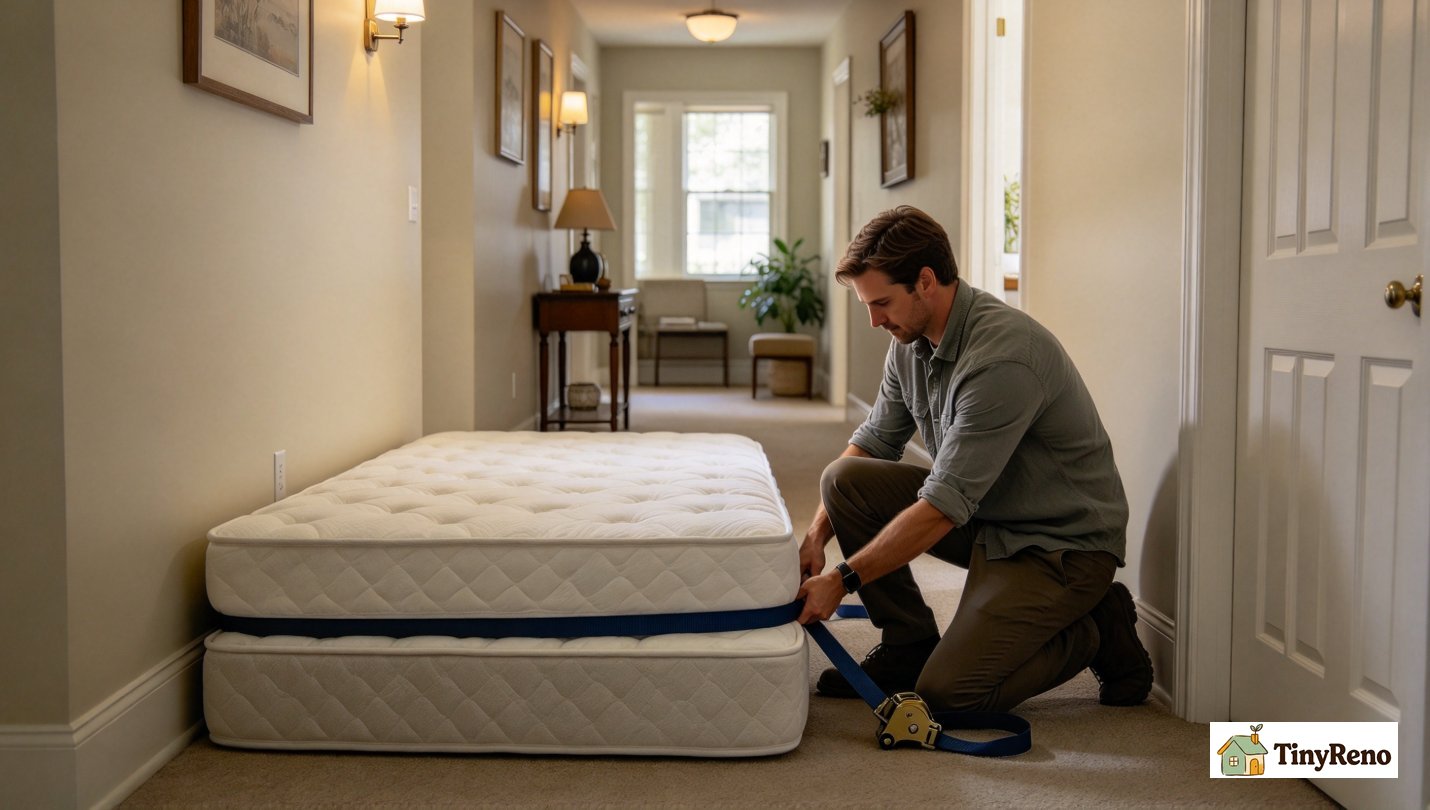
You need the ratchet strap, which is a $12 strap from the hardware store that wraps around the mattress when it is folded and holds the fold shut. Without the ratchet strap, the mattress unfolds in the middle of the stairs. I tried to fold a mattress without a strap the first time. The mattress unfolded on the seventh step. I fell on my back. I did not get hurt, but the mattress landed on top of me, and getting out from under a queen mattress on a stairwell landing is harder than it sounds. The strap is not optional. Buy the strap.
You need the mattress bag, which is the $14 Home Depot bag. The bag is not for dragging. The bag is for the truck. The bag keeps the mattress clean during the drive from the old apartment to the new apartment. The bag is also what you put the mattress in if it rains on move day. The bag is not a stair method. The bag is a flat-ground-and-truck tool. Use the bag for what it is for.
You need the dolly, which is the $12 U-Haul dolly. The dolly is for moving the mattress from the apartment door to the truck, and from the truck to the new apartment door. The dolly is not for stairs. The dolly is for flat ground. The dolly saves your back on the flat parts of the move.
You should skip the plastic wrap, which is the $9 shrink wrap the moving guys sell at the storage location. The plastic wrap does nothing the bag does not already do. The plastic wrap adds 10 minutes of wrapping time. The plastic wrap tears on the corner of the doorknob. Skip the plastic wrap.
You should skip the foam padding, which is the $22 foam pad the mattress store tries to sell you when you buy a new mattress. The foam padding is for protecting a mattress in a long-distance truck. The foam padding is not for a 20-block move in the city. The foam padding adds 30 pounds to the mattress weight. Skip the foam padding.
You should skip the mattress handles, which are the $8 strap set with four handles you sew onto the corners. Some modern mattresses come with built-in handles, but they are usually too far apart for one person to grip, and the sewn-on versions rip out of the fabric on the third step. The handles work for a king mattress being moved by two people. They do not work for a queen mattress being moved by one person. Skip them.
The 3 Things to Do Before You Move the Mattress
The 3 things to do before you move the mattress.
The first thing is to take the sheets and blankets off the mattress and put them in a separate bag. The mattress is heavy enough on its own. The sheets and blankets add 8 to 12 pounds. The sheets and blankets also get in the way of the fold. I learned this the second time I moved. The first time, I tried to move the mattress with the sheets still on. The sheets fell off on the fourth step. The sheets slid down the stairs ahead of me. The sheets are now in the stairwell of the Bushwick building. The landlord probably found them.
The second thing is to measure the stairwell turn. The stairwell turns 180 degrees at the landing. The turn is the part where the mattress gets stuck, not the straight part of the stairs. Measure the turn by walking up the stairs with a tape measure, or by measuring the width of the stairwell at the turn. The width of the stairwell at the turn is the part that decides whether the folded mattress fits through. A folded queen mattress is 30 inches wide. A stairwell turn is usually 36 inches wide. The folded mattress fits with 6 inches of clearance. If the stairwell turn is less than 36 inches wide, the mattress does not fit folded, and you need to either unfold the mattress and carry it flat up the stairs (which requires two people) or hire movers for the stair part.
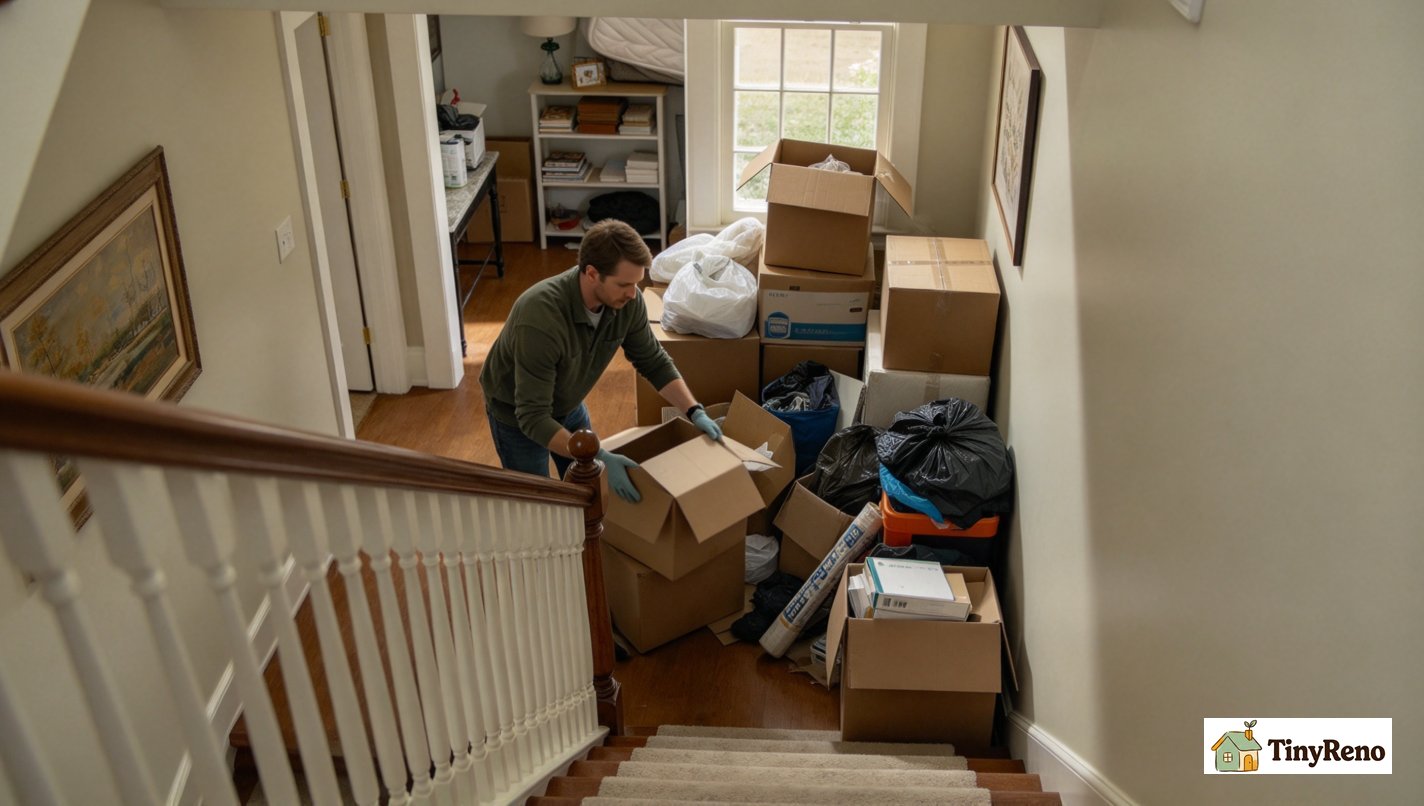
The third thing is to clear the stairwell of anything you might trip on. I left a box of books on the second-floor landing the first time. I did not see the box. I tripped on the box. I dropped the mattress on my foot. I did not break my foot, but I could have. The stairwell is not a place for boxes. The stairwell is a place for the mattress and the person carrying the mattress. Clear the stairwell before you start. If you feel any sharp pain in your back or shoulder while carrying, stop immediately and put the mattress down. A mattress is not worth a back injury.
The Stairs Are Where Mattresses Die
The stairs are where mattresses die, which is the part of how to move a mattress by yourself that no blog post writes about, because the blog posts are written by people who have not moved a queen mattress up three flights of stairs in Bushwick on a Saturday morning.
The stairs kill mattresses because the stairwell turn is the part of the move where the mattress has to change direction, and the mattress has weight, and the weight is on your shoulder, and your shoulder is at an angle, and the angle is the part where the mattress wants to keep going straight. The mattress wants to keep going straight up the stairs. The mattress does not want to turn at the landing. The mattress does not care that you are walking backwards. The mattress wants to keep going straight. You have to fight the mattress. The fight is where you hurt your back.
The way you fight the mattress without hurting your back is to lean into the turn. When the stairwell turns 180 degrees at the landing, you lean into the turn with your shoulder. You do not pull the mattress around the turn. You lean into the turn and let the mattress pivot around your shoulder. The pivot is what keeps the mattress from sliding off your shoulder. The pivot is what keeps the mattress from hitting the banister. The pivot is what gets the mattress through the turn in 8 seconds instead of 45 seconds. The pivot is the part you learn by doing it once. The first time you do it, you will hurt your shoulder. The second time you do it, you will not. The third time you do it, you will teach someone else.
What I Wish I Knew the First Time
What I wish I knew the first time, which is the last thing I want to tell you, because the first time is the time you do not have a friend and a context and a dolly and a strap and a Luis.
I wish I knew that the fold is the part that makes the method work, and the fold is not intuitive. The fold is not "fold the mattress in half and pick it up." The fold is "fold the mattress so the fold is exactly against your neck, so the bottom half of the mattress hangs behind your back, so the top half of the mattress is in front of your face." The fold puts the weight of the mattress on the top of your shoulders and the back of your neck. The fold keeps the mattress narrow enough to fit through the stairwell turn. The fold is the part that Luis taught me in 30 seconds. The fold is the part that no blog post has a photo of, because the photo would make the method look too easy, and the blog post wants the method to look like 5 steps and not 1 step.
If I were doing this over, and I had to move a queen mattress by myself up three flights of stairs in a walk-up with no friend and no dolly, I would buy the ratchet strap. I would fold the mattress. I would strap the fold. I would pick up the mattress on my shoulder. I would lean into the turn at the landing. I would walk up the rest of the stairs. I would put the mattress down on the top floor. I would take the strap off. I would unfold the mattress. I would put the mattress in the bag. I would carry the bag to the truck. The whole job takes 14 minutes for three flights of stairs. The whole job costs $26 for the strap and the bag. The whole job does not break the mattress. The whole job does not hurt your back. The whole job does not lose your deposit.
The fold is what makes the method work, and the fold is what I wish I knew the first time.


Discussion (0)
Sign in to join the discussion