

Laundry room accessories are what I started buying the month my post-college rental turned out to have a hallway closet instead of a laundry room, with a 110-volt outlet and a 24-inch-wide space between the wall and the bathroom door. The dryer was a folding rack from a discount store. The washer was a coin-operated one in the basement of the building next door, three flights down. I dragged my laundry in a plastic hamper once a week. By month four, the hamper was broken. By month six, I had bought four different accessories trying to make the hallway closet into something that functioned like a real laundry space. Three of those purchases failed. Three of them taught me something I now use in every rental since. The first accessory that survived was a $14 plastic detergent caddy. Six years later, it is still the one I reach for first.
What Survived 6 Years and 4 Moves
That was 2017 — six years ago as of this writing in 2023, and the accessories I bought then are still with me today. I have now lived in four different rentals — a Brooklyn studio, a Sunnyside one-bedroom, a Long Island City two-bedroom, and the Astoria one-bedroom I share with my partner — and I have fitted out four different laundry setups with the same set of laundry room accessories. Two of those setups were in-unit closet spaces. Two were shared rooms in the basement. The accessories that survived six years and four moves are six in number. The ones I threw out or returned are three. The difference between the two groups comes down to three things: whether they need to be drilled into the wall, whether they collapse flat for moving day, and whether they rust in a humid basement. The cheapest laundry room accessory on my permanent list cost $8. The most expensive cost $38. The one that worked best for the longest cost $14, and it was not the one I expected to keep.
The 6 Accessories That Earned a Spot
Start with an over-the-door drying rack. Forget the wall-mounted ones — you cannot drill into a rental wall. The over-the-door kind hangs on the back of the laundry closet door or the bathroom door, has three or four horizontal rods, and folds flat when not in use. A 4-rod chrome rack costs $18 to $28 and holds a full load of delicates without sagging. I have used the same $22 rack in three apartments now. The mistake people make with these is buying the wire-grid kind, which has horizontal wires instead of rods — the wires leave creases in knit shirts. Buy the rod kind. The rods are 1/4-inch-diameter solid steel and leave no creases at all.
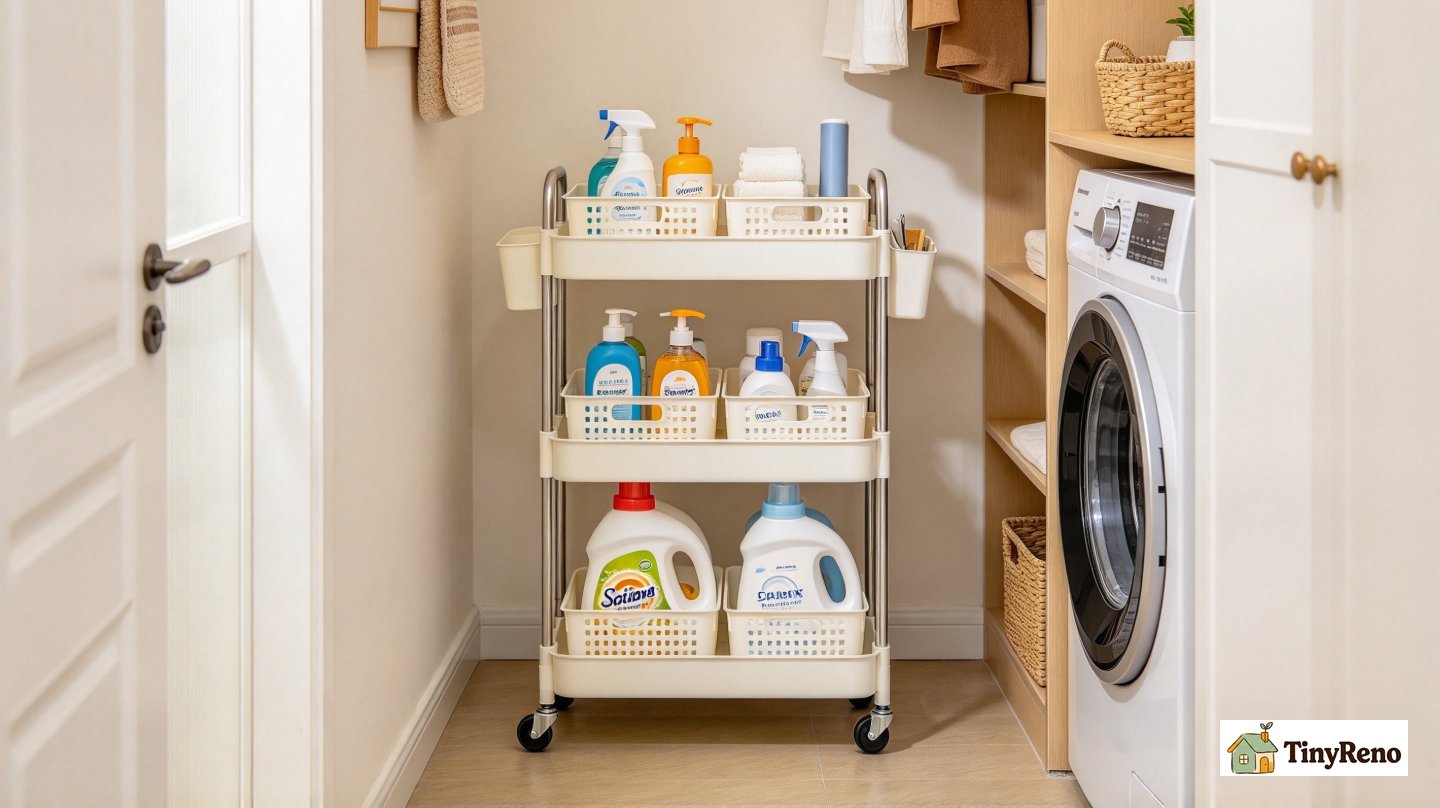
Next is a rolling laundry cart — the $12 cart that beat the $90 shelf. I bought a 3-tier rolling cart from a kitchen supply store for $12 on clearance, intended for vegetables. It turned out to be the best laundry room accessory I have ever owned. The top shelf holds detergent and dryer sheets. The middle shelf holds stain treatment spray and a lint roller. The bottom shelf holds a mesh bag of dryer balls and a folded drying rack. The wheels lock. The cart rolls out of the closet when I need it and rolls back in when I am done. The $90 wall-mounted shelf I tried before the cart required drilling four holes into the drywall, and when I moved out of the Brooklyn studio I had to patch and paint over every hole. The cart came with me. It is in this apartment's laundry closet right now.
A wall-mount hook strip — the kind with three or four adhesive hooks that holds a row of hangers — almost never makes a list, but if you air-dry button-down shirts or blouses, you need somewhere to hang them after the drying rack. A 4-hook adhesive strip costs $6 to $10 and goes on the inside of the laundry closet door with two strips of removable adhesive. I have used the same $8 strip in two apartments. The mistake people make is buying the suction-cup version for tile or glass — the suction cups fail within a week on any surface that is not perfectly smooth. Buy the adhesive kind, and buy the kind with metal hooks, not plastic.
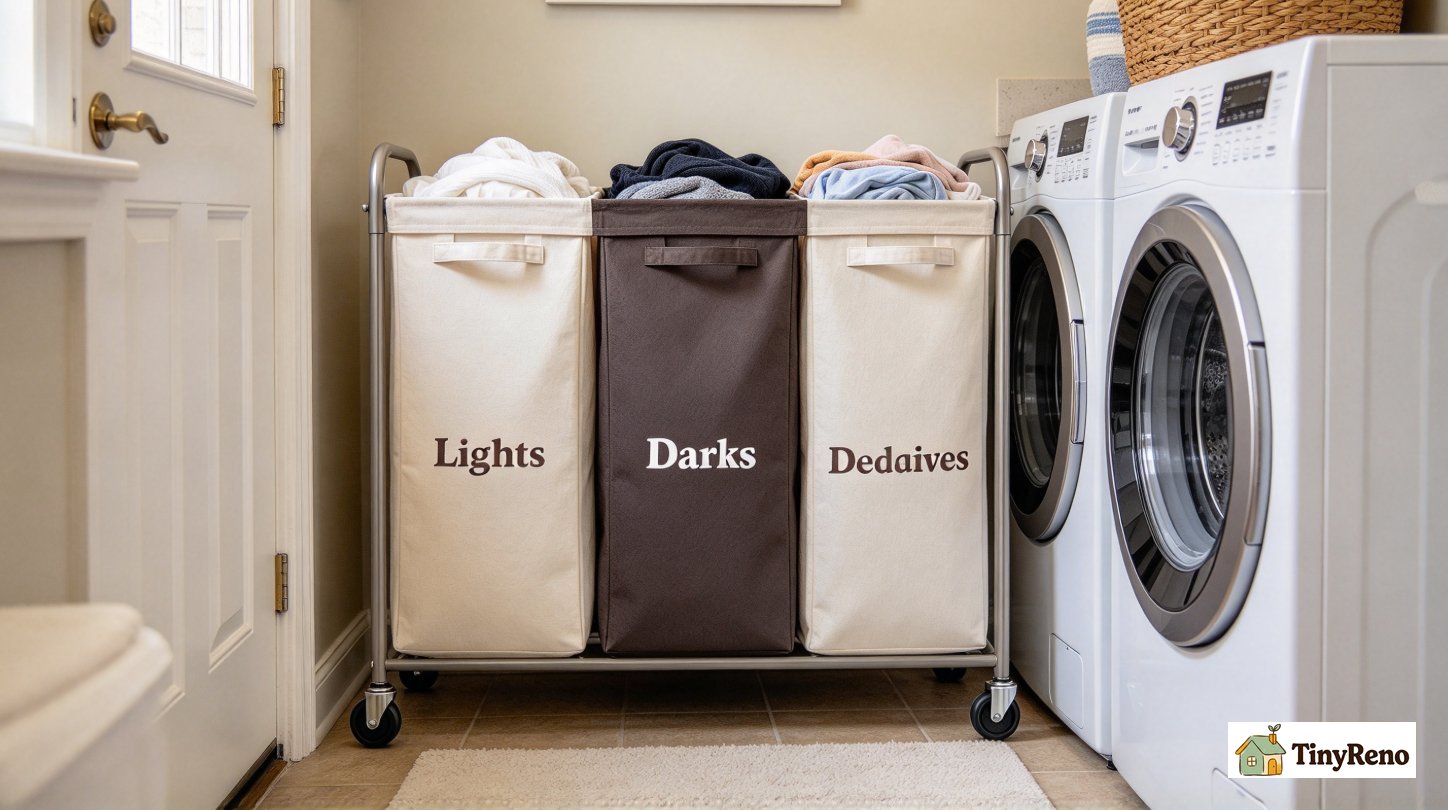
A sorter hamper, but only if you do not already sort in the bedroom. If you sort clothes in the bedroom, skip this one. If you sort at the laundry site — which is what I do in the basement shared laundry room — a 3-section sorter hamper on wheels is the only way to go. The one I use is a $32 canvas hamper from a home goods store with three separate bags: lights, darks, and delicates. It collapses flat for moving. The mistake people make is buying a single-bag hamper, which defeats the purpose. If you have to sort at the hamper, you will not sort. Three bags, three sections, one wheel to the laundry room.
A detergent caddy — the $14 fix I did not expect to keep. I bought a small plastic caddy with a handle — the kind people use for cleaning supplies — for $14 at a discount store. It holds two bottles of detergent, one bottle of stain remover, and a small jar of dryer sheets. The caddy sits on top of the washing machine. When I need to refill, I carry the caddy to the kitchen sink, fill the bottles, and carry it back. The reason I like this better than leaving detergent bottles on the washing machine is that the bottles always tip over, always leak, and always leave a film on the machine that I have to clean every month. The caddy catches the leaks and is easy to wipe clean. The mistake people make is buying a metal caddy, which rusts in a humid basement in six months. Buy plastic.
A folding drying rack for items that cannot go in the dryer. I already mentioned the over-the-door drying rack, but that is for items that hang vertically. For items that need to lay flat — sweaters, knit dresses, anything that stretches under its own weight when wet — you need a flat folding rack. The accordion-style wooden folding rack costs $30 to $50 and folds down to 2 inches thick for storage. I have used the same $38 wooden rack for five years. The mistake people make is buying the plastic mesh accordion kind — they warp under the weight of a wet sweater within a year. The wooden kind, with cotton cords instead of plastic mesh, lasts five years plus. If you have to pick only one laundry room accessory from this whole list, make it the wooden drying rack.
The 3 Accessories I Will Never Buy Again
Now the three accessories I will never buy again. First, the wall-mounted ironing board cabinet. It looked great in the product photo. It cost $80. It required four drilled anchors into the wall. When I moved out of the Brooklyn studio I had to patch four holes, repaint a 24-inch section of wall, and discovered the cabinet itself was warped from the humidity. The folded ironing board inside had mildew on it. I threw the whole thing out. Use a full-size ironing board that leans against the wall. It costs $25. It folds flat. It does not require drilling. Second, the wall-mounted retractable clothesline. Same problem — drilling, patching, and the line itself frayed within a year. Skip. Third, the mesh laundry bag that hangs on the door. The mesh tore at the seam within three months. Use a plastic laundry basket instead. Costs $5. Lasts five years.
What I Actually Use After 6 Years
What I actually use now, after six years and four moves, is the rolling $12 cart, the over-the-door $22 drying rack, the $8 adhesive hook strip, the $32 sorter hamper, the $14 plastic detergent caddy, and the $38 wooden folding drying rack. Total cost $126. None of it required drilling. All of it collapsed flat or rolled out cleanly when I moved out of the last apartment. The landlord in Sunnyside gave me the full security deposit back, and the only thing she commented on was that the laundry closet was cleaner than when I moved in. That is the test that matters for a renter: can you take the whole setup with you, and does the space look better than you found it.
If your rental laundry situation is a closet, a corner, or a shared basement room, the laundry room accessories that will actually work for you are six in number: an over-the-door rod-style drying rack, a 3-tier rolling cart, an adhesive metal hook strip, a 3-section sorter hamper on wheels, a plastic detergent caddy, and a wooden folding drying rack. Skip the wall-mounted ironing board cabinet. Skip the retractable clothesline. Skip the mesh door-hanging bag. Buy plastic, not metal, in humid basements. And buy rod-style, not wire-grid, for any drying rack.


Discussion (0)
Sign in to join the discussion