

Termites vs carpenter ants was the question I asked out loud in my Brooklyn rental at 11 p.m. on a Thursday in late April 2023, when I dropped a kitchen towel on the floor and saw something move under it. Not the towel. Something under it. A small, dark, winged shape, maybe half an inch long, sitting on the tile like it owned the place. I killed it with a shoe. Then I saw the second one, on the window frame above the sink. Then the third, on the counter, halfway between the kettle and a stack of mail I had been ignoring for a week.
I did not know what I was looking at. I knew the words "termite" and "carpenter ant" separately, but I had never tried to tell them apart in the wild, and the difference matters in a way I did not fully understand until later that month. Termites in a rental almost always mean someone else is paying for the repair, and almost never the renter. Carpenter ants in a rental mean the renter is on the hook for whatever they are chewing, and the landlord may not even want to know it is happening. If you mix the two up, you can spend four hundred dollars on the wrong professional, or you can fail to report damage you were legally required to report within seven days of noticing it, and either of those mistakes will cost you the deposit you walked in with.
This is the decision tree I wish someone had handed me at 11 p.m. that night. It is not a guide to extermination. It is a guide to looking at a bug, asking five questions, and figuring out which one you are looking at, and what to do about it before you call anyone, sign anything, or lie to your landlord about what you found.
What "winged" actually tells you, and what it doesn't
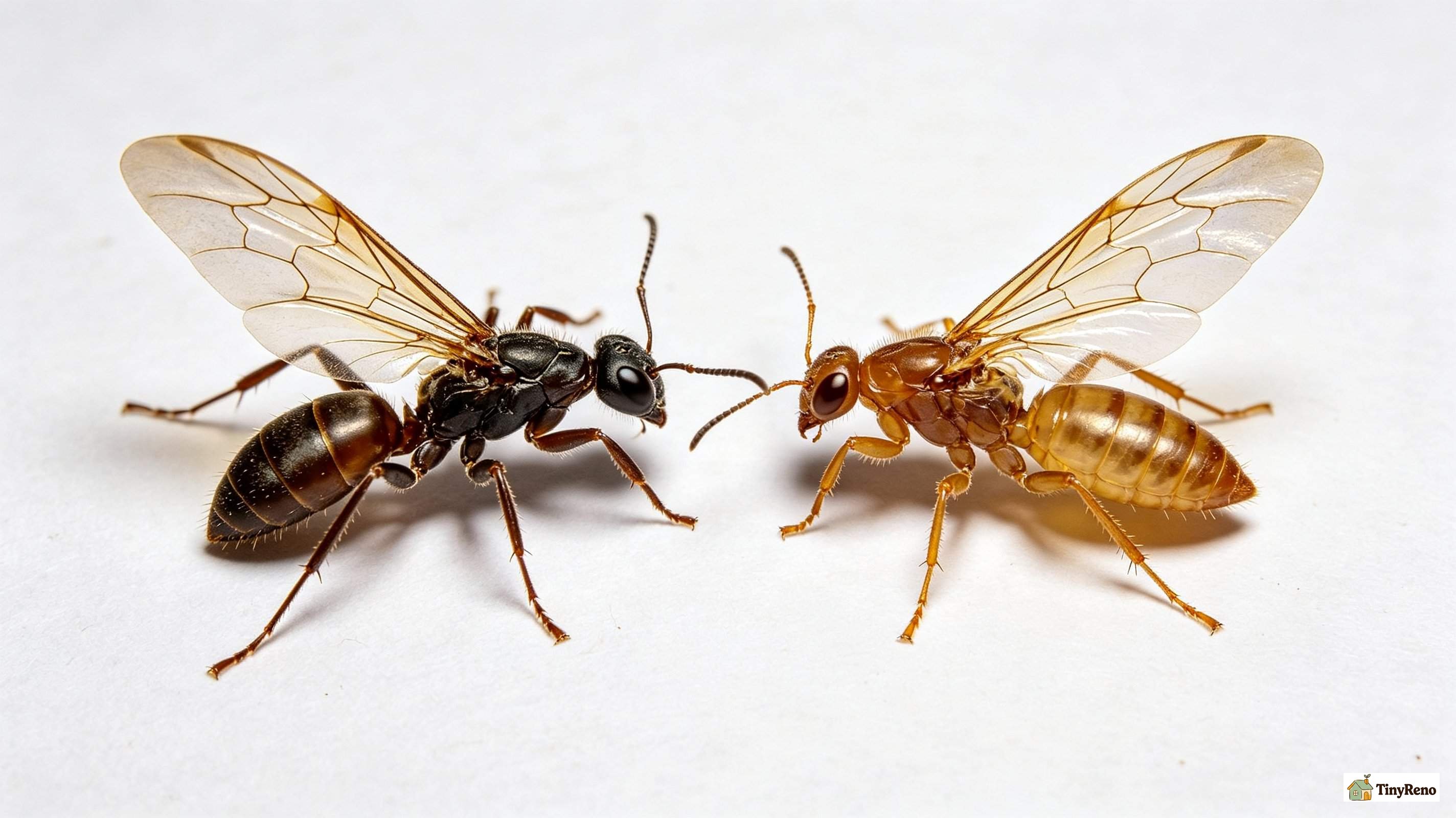
Both termites and carpenter ants have a winged version that shows up in spring, usually after a warm rain. They are called alates, and they are the colony's reproductives — the ones that leave the nest, fly a short distance, drop their wings, and try to start a new colony with whoever they mate with. Most of them fail. Most of them die within a day or two, which is why you find wings near windows and dead bodies on sills without ever seeing the bug itself.
The reason winged matters is that almost no other ant or termite problem announces itself this loudly. If you are seeing winged insects indoors, in numbers larger than one or two, you are not seeing scouts. You are seeing a colony that has been living somewhere in the building long enough to mature, swarm, and try to expand. That is true for both species. The rest of the differences come down to the body, not the wings.
Five questions to tell them apart

Question one: antennae. Carpenter ants have bent, elbowed antennae. If you look closely at a specimen on a window sill, the antenna will have a clear kink in the middle, like a little arm bent at the joint. Termite antennae are straight, beaded, and look like a string of tiny pearls. This is the single most reliable field mark, and it works on dead specimens as long as the antennae are not crushed.
Question two: waist. Carpenter ants have a pinched waist, with a clear narrowing between the thorax and the abdomen, almost like a wasp shape but smoother. Termites have a straight-sided body, like a grain of rice with legs, no pinch, no narrow segment. If the bug looks like two sections attached by a thread, it is a carpenter ant. If it looks like one continuous capsule, it is a termite, and the rest of this decision tree is the part that decides who is paying for what.
Question three: wings. Both have four wings, but they are not the same size. On a termite, the front and back wings are the same length, and they extend well past the body, and they tend to break off cleanly along a fracture line after the swarmer lands. On a carpenter ant, the front wings are noticeably longer than the back wings, and they do not have a clean break point. If you find piles of identical-length wings near a window, with no bodies, you almost certainly have termites. If the wings you find are uneven in length and still attached to bodies, you almost certainly have carpenter ants.
Question four: color and size. Eastern subterranean termites, which is what most U.S. rentals will see, are pale, creamy brown to almost translucent black, and they are small, around an eighth to a quarter inch long, including wings. Carpenter ants are usually darker — black, reddish-black, or black with a reddish thorax — and they are noticeably bigger, around a quarter to half an inch long, including wings. Size is not a clean call because the two overlap, but if the bug is large and dark, the bias shifts to carpenter ant.
Question five: damage. This is the one that takes longer to answer and that you should not wait to start asking. Termites eat wood from the inside out. They tunnel along the grain, pack the tunnels with mud and frass, and leave a thin shell of paint or wood veneer on the outside that looks fine until you press it. Carpenter ants do not eat wood. They hollow it out to build nests, and they push the sawdust-like residue out of the entry hole in a cone-shaped pile. If you tap a suspicious piece of wood and it sounds hollow, that is consistent with both. If you find a small pile of what looks like sawdust under a hole, that is carpenter ant frass, not termite damage.
Who pays when you find them
This is where the renter calculus differs sharply between the two. In most U.S. jurisdictions, and under most standard leases I have signed in New York, New Jersey, and Massachusetts, the landlord is responsible for structural damage from termites, because termite damage is treated as a habitability problem — the building is being eaten, the renter cannot prevent it, and the repair requires professional treatment that the renter is not licensed or equipped to perform. Almost no lease I have ever read puts termite treatment on the renter.
Carpenter ants are usually the opposite. They are treated as a maintenance issue closer to a cockroach or a mouse infestation: the renter is expected to report it promptly, keep the kitchen clean, not store wet wood indoors, and allow the landlord to schedule treatment. If the renter reports a carpenter ant infestation within a reasonable window—usually seven to thirty days, depending on your state and lease—and the landlord ignores it for weeks, the responsibility can shift back. But the renter who ignores a known carpenter ant problem for three months and then tries to claim it was pre-existing will lose that argument at move-out.
If you cannot tell which one you have, the safe move is to treat it as termites vs carpenter ants until you can prove which one it is. Take clear photos, save a dead specimen in a zip-top bag in the fridge, write down the date and time you noticed it, and email your landlord the same day. That email does two things: it starts the clock on habitability if it turns out to be termites, and it protects your deposit if it turns out to be carpenter ants. Either way, you want a paper trail that you noticed on day one and not on day ninety, and you want the words "termites vs carpenter ants" out of your mouth the first time you describe what you saw.
What I did wrong the first time
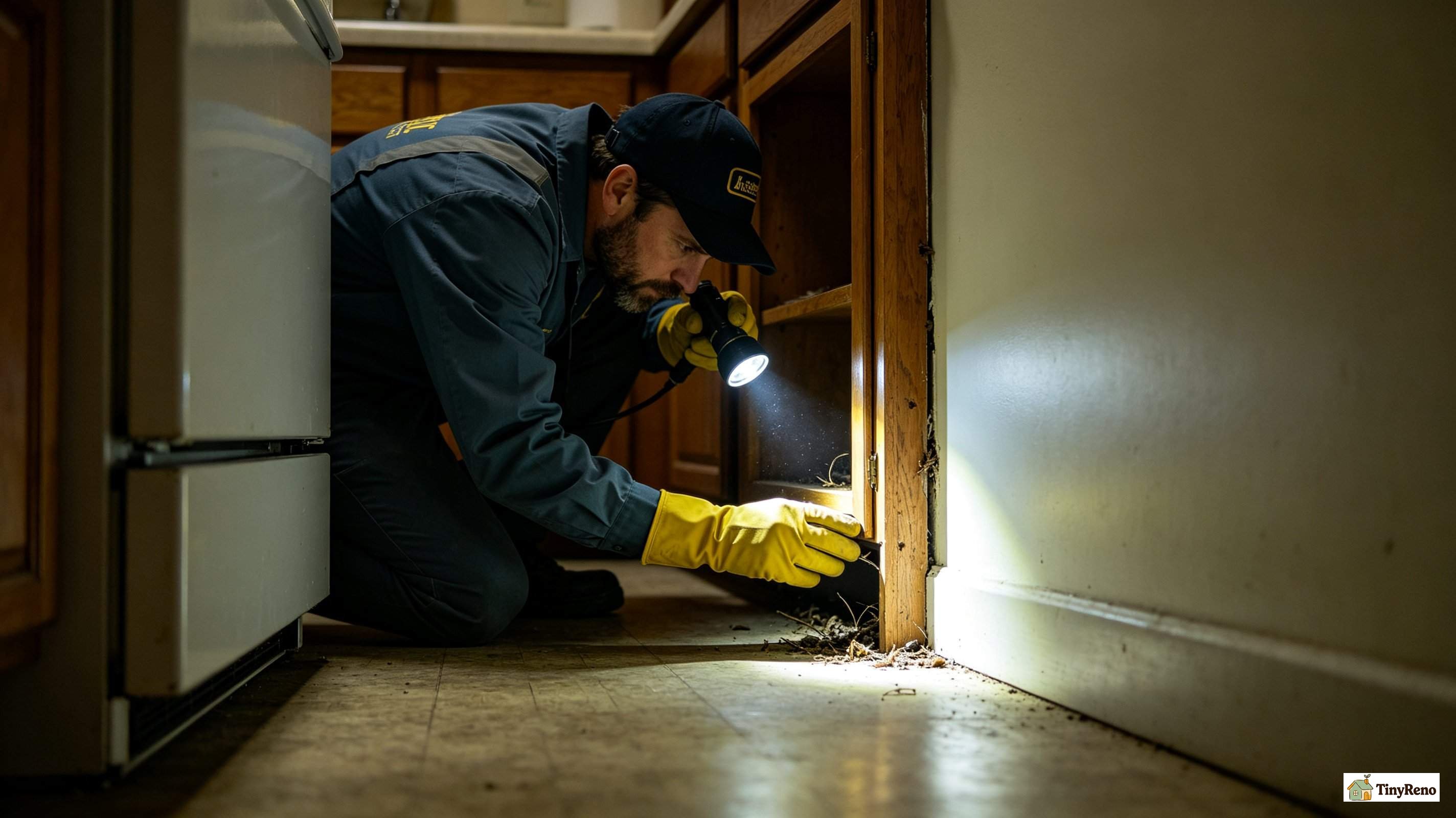
The first time I saw a winged ant in that Brooklyn kitchen, I told my landlord by text the next morning, and he wrote back two words: "Will spray." I let it go. I should not have. Three weeks later, the exterminator he sent found a satellite carpenter ant colony in the wall behind the refrigerator. The repair—drilling, bait stations, sealing entry points—was billed to me. The lease said I had to identify the pest to the best of my ability, and my initial text had said "ant," not "carpenter ant." I had not.
The second time, a year later in a different unit, I saw a winged insect on the bathroom floor at 7 a.m. on a Tuesday. This time I took a photo, killed it without crushing the antennae, put it in a bag, and emailed my landlord within the hour with the photo, the time, and the words "winged insect, possible termite swarm, please advise." She had an exterminator on site by Thursday. The treatment was covered by her, because it was a small subterranean termite colony under the front steps, and the lease language on termites was unambiguous. The cost was zero to me. The difference was that I had used the right word in the first sentence of the first email.
The short version, before you call anyone
If the antennae are bent and the wings are uneven, it is a carpenter ant. The damage is yours to report, and yours to be blamed for if you do not. Clean the kitchen, seal any food in hard containers, and email your landlord today. If the antennae are straight, the wings are even, and you are finding identical-length wings on the windowsill, it is almost certainly a termite. The damage is almost certainly the landlord's. Photograph everything, save a specimen, and email your landlord today with the words "possible termite swarm" in the first sentence. If you cannot tell whether you are looking at termites or carpenter ants, use the words "winged insect" and attach a photo. That word choice is the single highest-leverage decision a renter makes in the first hour, and it is the one I kept getting right only by accident.


Discussion (0)
Sign in to join the discussion