

Rats in the attic was the conclusion I had to accept on a Tuesday in February sometime around 11 p.m., when the scratching came from directly above the bedroom my roommate Alex and I shared in our Cleveland rental. Alex was already in bed. I was on my laptop. The sound was a fast, light, rhythmic scratching, like a fingernail pulled slowly across a piece of wood, and it lasted about four seconds, stopped for about thirty, and then came back for another four. Alex did not react. I did not react. We had been in this rental for three months and we had been hearing this sound on and off for at least six weeks before I said anything about it, because the sound was always at 11 p.m. or later, and because I was tired, and because by the time you have heard something twice and decided to ignore it, you have also decided you do not have a problem. The problem, which it took me another month to take seriously, was that we had rats in the attic, and that the rats in the attic were different from the rats in the kitchen, and that the difference mattered in a way that the internet was not very clear about.
The internet is mostly about rats in the kitchen, rats in the garage, rats in the basement. Rats in the attic is its own entry, because the attic is a space the renter is usually not supposed to access, and because the cost of the fix is usually in the thousands of dollars and not in the hundreds, and because the fix requires a structural entry-point repair that the renter cannot legally perform, and because most leases I have read in Ohio, in Pennsylvania, and in the other three states I have rented in put attic access and structural repair squarely on the landlord. The kitchen rat problem is a problem you can half-solve with snap traps and a clean pantry. The attic rat problem is a problem you cannot half-solve with anything you can buy at a hardware store, and the sooner you stop trying to solve it that way, the sooner the actual problem gets fixed by the actual person whose job it is to fix it. That person is your landlord, and the email that starts the fix is the same email I should have sent in week one and did not send until week twelve.
I want to be clear about what the attic rat problem actually is, because the term "rats in the attic" gets used loosely online, and the actual situation is more specific. The rats are in the attic because there is a gap somewhere between the inside of the attic and the outside — a gap in the roof, a gap around a vent, a gap at the soffit, a gap where the siding meets the foundation. The rats did not get in through a door. They got in through a hole the size of a quarter, and they are in the attic because the attic is dark and warm and full of insulation they can shred for nesting material, and because nothing in the attic is competing with them for either of those resources. Once they are in, they are not going to leave on their own. The food source that brought them in is not the food source that is keeping them there. They will stay in the attic through the entire winter, even after the kitchen is clean, even after the garbage is sealed, even after you have not seen a rat on the main floor in a month. The fix is not to remove the food. The fix is to close the entry point. The fix is not a renter fix.
The four levels of evidence, from least to most reliable
The first level of evidence is sound, and it is the least reliable. Attic scratching at night is almost always rats, but it can also be squirrels, raccoons, opossums, or just the house settling in cold weather. I cannot tell you how many times I was sure the sound was a rat and then went up and found nothing, or found a loose piece of insulation flapping in a draft, or found a pine cone that had rolled down from the eaves. Sound alone is not enough. It is enough to make you go check, but it is not enough to call the landlord with.
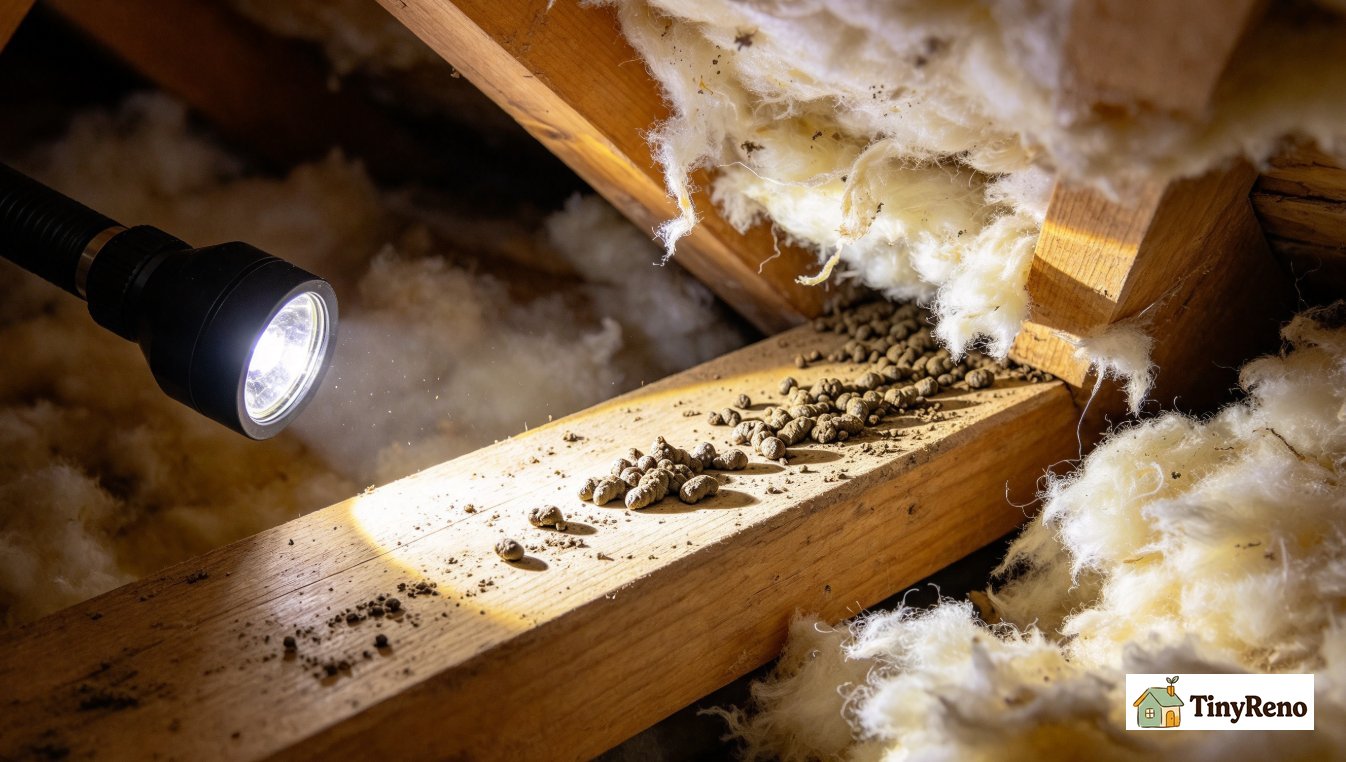
The second level of evidence is droppings. Attic rat droppings are similar to kitchen rat droppings—small, dark, shaped like a grain of rice—but they tend to be found in clusters in the attic, usually along the rafters or near the entry point, and they tend to be dry and dusty in a way that kitchen droppings are not, because they have been there longer and have not been disturbed. If you can safely look into the attic—some leases allow access, most do not—and you see droppings clustered in one corner, you are looking at an active or recently active nest. If the droppings are scattered, the rats may have moved on. Droppings are the evidence I should have looked for at week two instead of waiting until week twelve, and the evidence I would tell you to look for first.
The third level of evidence is gnaw marks. Rats in the attic will gnaw on anything they can reach, which in our attic was the insulation, the wiring, and the plywood that covered the access hatch from above. Gnaw marks on wiring are the part of the attic rat problem that can actually hurt you, because exposed wiring in an attic is a fire risk that the renter's insurance may not cover if it turns out to have been a known problem the renter ignored. If you see gnaw marks on wiring in your attic, that is not a "wait and see" problem. That is an email-to-the-landlord-the-same-day problem, with the words "gnawed electrical wiring in attic" in the first sentence, because those words put the landlord on notice for habitability in a way that "scratching sounds at night" does not.
The fourth level of evidence is the entry point itself. This is the evidence you cannot collect yourself without getting on a ladder, which is a thing you should not do as a renter unless your lease explicitly allows it, and most leases do not. The entry point is the landlord's evidence to collect, and the way to get the landlord to collect it is to send the email. The email says four things. It says we have heard scratching in the attic for twelve weeks. It says we have found droppings in the attic in a cluster near the front gable. It says we have not entered the attic to do any repair, because we are renters and the lease puts the attic on the landlord. It says we would like the entry point inspected and sealed, with photos of the work done, and we would like the wiring inspected for gnaw damage. That email is what moved the problem from "sounds we are ignoring" to "problem we have asked the landlord to fix," and the fix happened within ten days of the email.
What did not work, and why the renter trap idea does not work
The renter trap idea — the idea that I can buy a trap at the hardware store, set it in the attic, and solve the problem myself — does not work, and it did not work for me when I tried it for two weeks in November. The reason it does not work is not that the traps are bad. The traps catch rats. The reason it does not work is that you are treating a symptom, not a cause. The rats in your attic are not staying in your attic because there are not enough dead rats in your attic. They are staying in your attic because there is a hole in your attic. Closing the hole is the fix. Catching rats is a way to make yourself feel like you are doing something while the hole stays open and the next wave of rats comes in to replace the ones you caught. I caught three rats in the first two weeks. The scratching did not stop. I caught two more the third week. The scratching got louder, not quieter, because I had thinned the population and the survivors had more food and more nesting material per rat. I stopped setting traps the day I sent the email.
The other thing that did not work for me was peppermint oil, which I tried in the kitchen for a different reason back in October and which I had a half-empty bottle of when the attic scratching started. Peppermint oil in the attic, sprayed around the entry points I assumed existed, did nothing. Peppermint oil does not work on rats in the kitchen, and it does not work on rats in the attic, for the same reason — the rats are not afraid of the smell, they are at home in the space, and a novel smell that is mildly annoying does not displace them. I emptied the bottle, which was its own small waste of money, and which is the part of this I would skip if I had it to do over.
The third thing that did not work was waiting. I waited twelve weeks from the first scratching sound to the first email. The waiting did not make the problem smaller. The waiting made the problem larger, because rats breed, and because the rats that were in the attic in October were a small population, and the rats that were in the attic in January were a population that had been breeding for three months. The longer you wait, the more rats there are, the more entry points there are (rats chew holes to make new entry points once they are inside), and the more damage there is to the insulation and the wiring. The fix that took ten days in week twelve would have taken four days in week two, and the entry point would have been a quarter-sized hole instead of a hole the size of a grapefruit.
What worked, and what the email should actually say
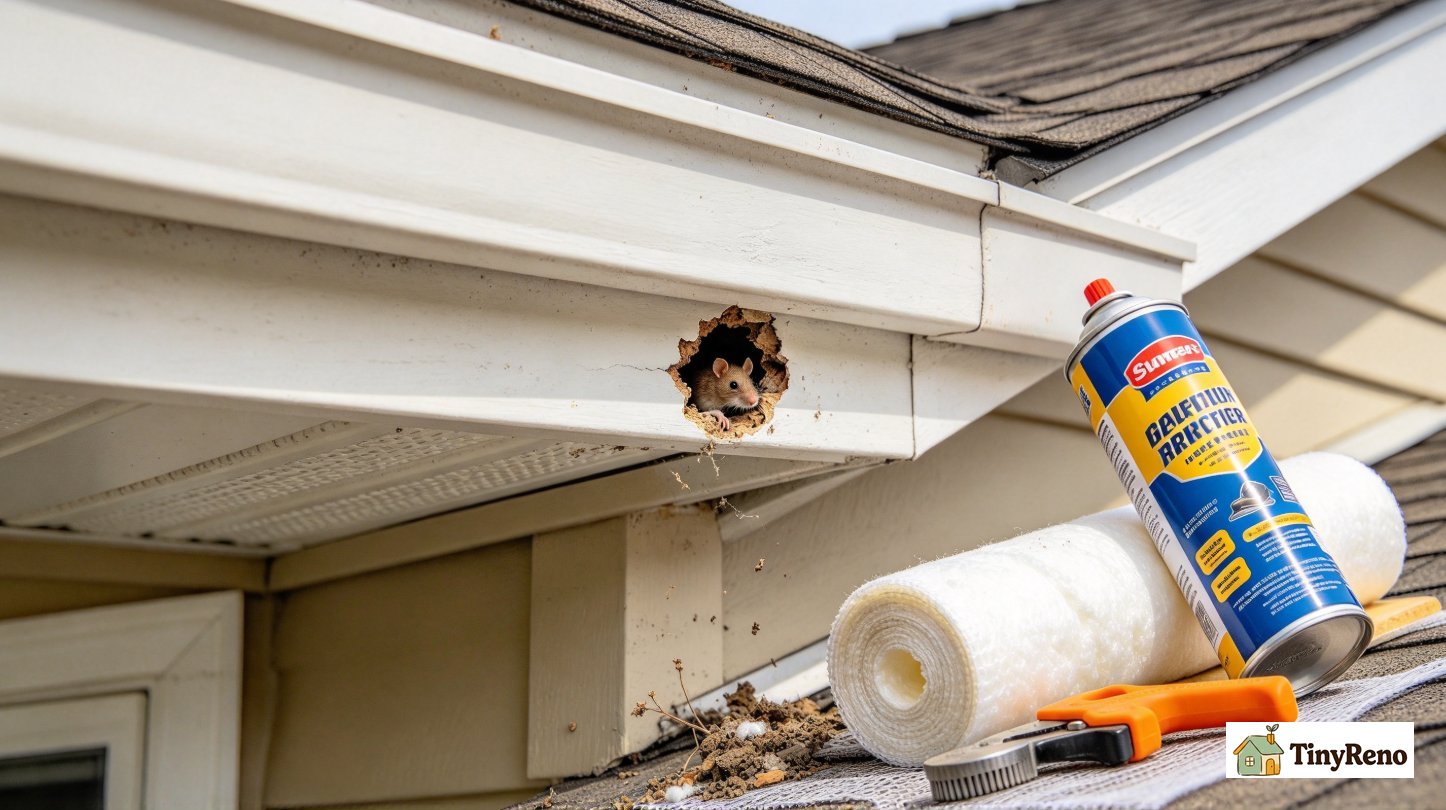
The email that worked, sent at 7 a.m. on a Tuesday in February, said four things in plain language. It said we have heard scratching in the attic over the bedroom for the past twelve weeks. It said the sound is consistent and nighttime-only, which is the pattern of a rodent and not of the house settling. It said we have not entered the attic, because the lease puts the attic on the landlord. It said we would like an inspection of the attic, an identification and sealing of any entry points, an inspection of the wiring for gnaw damage, and a follow-up visit in 30 days to confirm no new activity. The maintenance man was at our door at 10 a.m. the next day with a flashlight, a ladder, and a can of spray foam. The entry point was a quarter-sized hole at the soffit, exactly where I had assumed it was in November. He sealed it with hardware cloth and spray foam, sealed two smaller holes he found while he was up there, and inspected the wiring. The wiring was gnawed on one circuit, which he wrapped with electrical tape and flagged for an electrician. The electrician came the following week.
The cost of the fix, the electrician, the spray foam, and the hardware cloth were all billed to the landlord. The cost of the lost sleep, the three nights I lay awake listening to the scratching, and the two weeks I spent setting traps in the attic that did nothing, was billed to me, and was the part of this I would skip if I had it to do over. The fix was not complicated. The fix was not expensive. The fix took one morning of one maintenance visit and one afternoon of one electrician visit. The fix was always within the landlord's capability. The thing that kept the fix from happening was me not sending the email, because I had convinced myself the sound was the house settling, and because I did not want to be the renter who complained about noises, and because I did not know that "gnawed electrical wiring in attic" was a phrase that would move the email from a regular maintenance ticket to a habitability ticket. The phrase would have moved it in week one, and it would have moved it in week twelve, and the difference between those two weeks is the difference between a $200 fix and a $1,200 fix, and the difference between no electrical damage and one circuit of electrical damage. The hazard is not the rats. The hazard is the gap between when you first hear the sound and when you send the email.
The short version, before the next scratching night
If you are hearing scratching in the attic of your rental at night, and the sound is consistent and rhythmic and nighttime-only, and you have been hearing it for more than a week, you are most likely hearing rats, and the rats are most likely getting in through a gap somewhere on the outside of the building. The fix is not the renter's. The fix is the landlord's. The fix involves a ladder, a flashlight, hardware cloth, spray foam, and possibly an electrician. None of those things are in your lease as renter responsibilities, and all of them are in your lease as landlord responsibilities, in most jurisdictions and most standard leases I have read. The thing to do this week, before the next scratching night, is to write the email. The email should say four things. It should say you have heard the sound. It should say the pattern is consistent and rodent-shaped. It should say you have not entered the attic. It should say you would like an inspection, a sealing of any entry points, and a follow-up in 30 days. If the landlord does not respond within five business days, send the second email referencing the relevant habitability statute. The rats are not afraid of you, and peppermint oil is not going to do anything, but the landlord is afraid of paper trails, and a paper trail is what makes the difference between a $200 fix in week two and a $1,200 fix in week twelve, and between this apartment and the next one you have to clean up at move-out.


Discussion (0)
Sign in to join the discussion